Blog Post #32: AI for Underwater Domain Awareness — Illuminating the Hidden Battlefield
The ocean remains opaque. Multi-modal fusion, federated learning, and edge AI change that.
Blog Post #32: AI for Underwater Domain Awareness — Illuminating the Hidden Battlefield
Date: July 8, 2026
Author: We are an IDEaS CFP-006 applicant
Tags: underwater domain awareness, multi-modal fusion, maritime defence, acoustic sensing, AI at the edge, federated learning, NORAD, maritime security
The Problem: The Ocean Remains Opaque
Over 70% of the Earth's surface is covered by water, yet our ability to monitor, understand, and act in the underwater domain lags far behind air and space domains. For the Royal Canadian Navy, NORAD, and allied forces, this opacity creates critical blind spots: undetected submarine transits, unexploded ordnance on training ranges, illegal fishing in the Arctic, and autonomous underwater vehicles operating without attribution.
Traditional underwater sensing relies on passive sonar arrays, magnetic anomaly detectors, and sporadic patrol craft — each generating fragmented, noisy data streams that rarely converge into a coherent picture. The physics of the underwater channel (sound propagation, multipath, absorption, ambient noise from shipping and marine life) makes sensor fusion exponentially harder than in air or space. The result: decision-makers operate with stale, incomplete, or contradictory intelligence.
The NovaFuse Approach: Multi-Modal Fusion at the Tactical Edge
NovaFuse's architecture addresses underwater domain awareness through three interlocking capabilities:
1. Heterogeneous Sensor Fusion
Fusing passive/active sonar, magnetic, optical, and environmental sensors (temperature, salinity, current profiles) into a unified probabilistic track. Our multi-modal transformer architecture learns cross-modal correlations — e.g., how a thermal front correlates with acoustic ducting that masks a contact — without requiring hand-crafted feature engineering.
2. Federated Learning Across Distributed Assets
Underwater platforms (submarines, UUVs, seabed arrays, surface vessels) cannot maintain persistent high-bandwidth links. FedEdge, our federated learning framework, trains local models on each platform using raw sensor data, then exchanges only model updates (encrypted, compressed) when connectivity permits. This preserves operational security while building a globally consistent underwater picture.
3. Edge Inference Under Extreme Constraints
Subsea compute is power-limited, thermally constrained, and often radiation-hardened. Our quantization-aware training pipeline compresses models to INT4/INT8 with <2% accuracy loss, enabling real-time contact classification and anomaly detection on embedded GPUs (Jetson Orin, NVIDIA DRIVE) or FPGA accelerators.
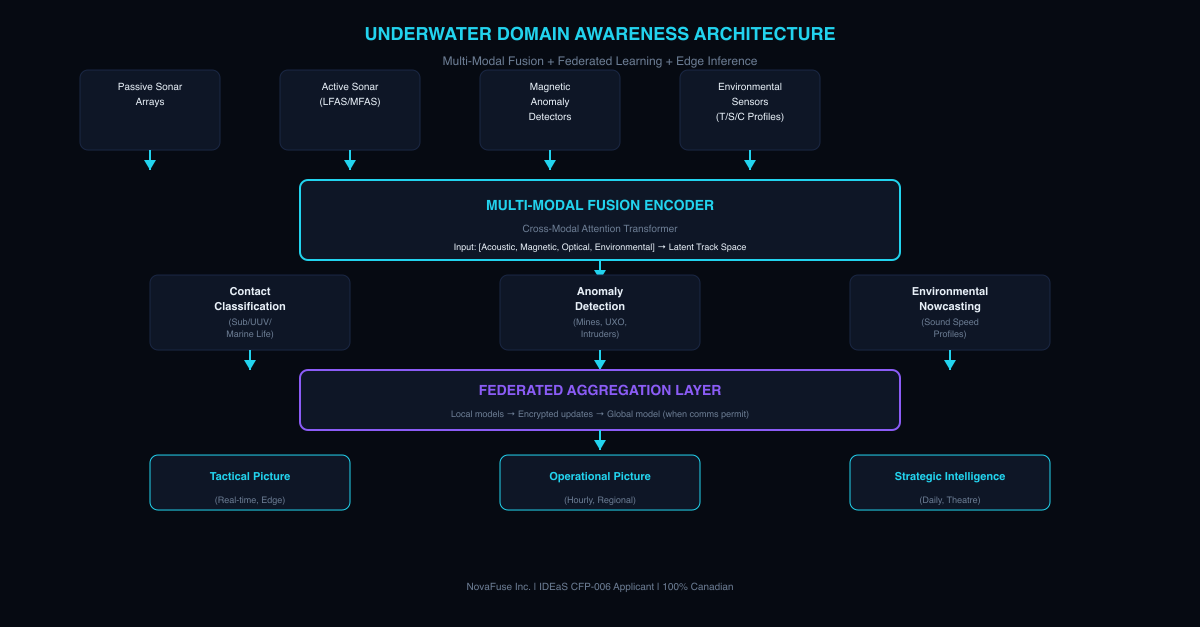
Architecture Overview
┌─────────────────────────────────────────────────────────────────────────────┐
│                        UNDERWATER DOMAIN AWARENESS ARCHITECTURE              │
├─────────────────────────────────────────────────────────────────────────────┤
│                                                                              │
│   ┌──────────────┐    ┌──────────────┐    ┌──────────────┐    ┌──────────┐ │
│   │  Passive     │    │  Active      │    │  Magnetic    │    │ Environ- │ │
│   │  Sonar       │    │  Sonar       │    │  Anomaly     │    │ mental   │ │
│   │  Arrays      │    │  (LFAS/MFAS) │    │  Detectors   │    │  Sensors │ │
│   └──────┬───────┘    └──────┬───────┘    └──────┬───────┘    └────┬─────┘ │
│          │                   │                   │                   │       │
│          └───────────────────┼───────────────────┼───────────────────┘       │
│                              ▼                   ▼                           │
│                    ┌──────────────────────────────────────────┐              │
│                    │     MULTI-MODAL FUSION ENCODER           │              │
│                    │  (Cross-Modal Attention Transformer)     │              │
│                    │  Input: [Acoustic, Magnetic, Optical,    │              │
│                    │   Environmental] → Latent Track Space    │              │
│                    └────────────────────┬─────────────────────┘              │
│                                         │                                     │
│                    ┌────────────────────┼─────────────────────┐              │
│                    ▼                    ▼                     ▼              │
│           ┌───────────────┐    ┌───────────────┐    ┌───────────────┐       │
│           │  Contact      │    │  Anomaly      │    │  Environmental│       │
│           │  Classification│   │  Detection    │    │  Nowcasting   │       │
│           │  (Sub/UUV/    │    │  (Mines, UXO, │    │  (Sound Speed │       │
│           │   Marine Life)│    │   Intruders)  │    │   Profiles)   │       │
│           └───────┬───────┘    └───────┬───────┘    └───────┬───────┘       │
│                   │                    │                    │                │
│                   └────────────────────┼────────────────────┘                │
│                                        ▼                                     │
│                    ┌──────────────────────────────────────────┐              │
│                    │       FEDERATED AGGREGATION LAYER        │              │
│                    │  Local models → Encrypted updates →      │              │
│                    │  Global model (when comms permit)        │              │
│                    └────────────────────┬─────────────────────┘              │
│                                         │                                     │
│                    ┌────────────────────┼─────────────────────┐              │
│                    ▼                    ▼                     ▼              │
│           ┌───────────────┐    ┌───────────────┐    ┌───────────────┐       │
│           │  Tactical     │    │  Operational  │    │  Strategic    │       │
│           │  Picture      │    │  Picture      │    │  Intelligence │       │
│           │  (Real-time,  │    │  (Hourly,     │    │  (Daily,      │       │
│           │  Edge)        │    │  Regional)    │    │  Theatre)     │       │
│           └───────────────┘    └───────────────┘    └───────────────┘       │
│                                                                              │
└─────────────────────────────────────────────────────────────────────────────┘
Why This Matters for Canadian Defence
Arctic Sovereignty
The Canadian Arctic archipelago contains thousands of kilometers of coastline and choke points (Northwest Passage, Nares Strait, Davis Strait) that are effectively unmonitored underwater. Ice-covered waters defeat optical and surface radar; only acoustic and magnetic sensing penetrate. A federated, edge-capable UDA network deployed on Arctic Offshore Patrol Ships (AOPS), seabed arrays, and UUVs would provide persistent awareness without requiring vulnerable satellite links.
NORAD Modernization
NORAD's maritime warning mission currently depends on surface radar and space-based AIS. Subsurface threats — adversary SSNs, XLUUVs, seabed warfare platforms — are invisible to these systems. Integrating UDA into NORAD's layered sensor architecture closes the "water column gap" and enables cueing of air/space assets from underwater detections.
IDEaS CP-CFP10 Alignment
The IDEaS CP-CFP10 "Reliable AI sensor fusion for real world missions" challenge explicitly seeks multi-sensor, multi-domain fusion with compliance-by-design. Our UDA architecture demonstrates: - Multi-domain fusion: Acoustic + magnetic + optical + environmental - Edge compliance: Quantized models with formal verification artifacts - Federated governance: Audit trails for every model update exchange - Canadian data sovereignty: All training/inference on Canadian infrastructure
Technical Differentiators
| Capability | Traditional Approach | NovaFuse UDA |
|---|---|---|
| Sensor modalities | Single (passive sonar) | 4+ (acoustic, magnetic, optical, environmental) |
| Compute location | Shore-based fusion centres | Tactical edge (sub/UUV/buoy) |
| Connectivity req. | Persistent high-bandwidth | Intermittent, low-bandwidth (federated) |
| Classification latency | Minutes-hours | <500ms (INT8 edge) |
| Model update cycle | Months (centralized retrain) | Hours-days (federated) |
| Export control posture | Often ITAR-encumbered | Canadian-designed, CGP-compliant |
Deployment Pathway
-
Phase 1 (TRL 4-5, 12 months): Lab validation on synthetic and recorded datasets (DRDC Atlantic, NATO CMRE). Deliverable: containerized fusion stack with quantified performance bounds.
-
Phase 2 (TRL 6, 18 months): At-sea trials on AOPS and XLUUV (Cellula Robotics Solus-LR). Integration with CMS 330 and TRIDENT combat systems. FedEdge validation over SATCOM/LTE-denied links.
-
Phase 3 (TRL 7-8, 24 months): Operational deployment on Arctic patrol cycle. NORAD maritime warning integration. IDEaS Component 1b proposal for production scaling.
The Strategic Imperative
Underwater domain awareness is not a niche capability — it is the missing layer in continental defence. As adversaries field larger UUV fleets, seabed sensor networks, and autonomous mine-laying systems, the cost of opacity compounds. Canada's geography (three oceans, the world's longest coastline, an Arctic frontier) makes UDA a sovereign necessity, not an optional enhancement.
NovaFuse is building the fusion stack that turns fragmented underwater noise into decision-grade intelligence — at the edge, under ice, and on Canadian terms.
Next in the series: AI for Space-Based Maritime Surveillance — Fusing Orbital and Oceanic Intelligence
We are an IDEaS CFP-006 applicant. This article reflects NovaFuse's independent research and does not represent the views of the Department of National Defence, the Canadian Armed Forces, or any government agency.
We are an IDEaS CFP-006 applicant. This article reflects NovaFuse's independent research and does not represent the views of the Department of National Defence, the Canadian Armed Forces, or any government agency.