AI for Urban Intelligence — Turning City Data into Real-Time Insight
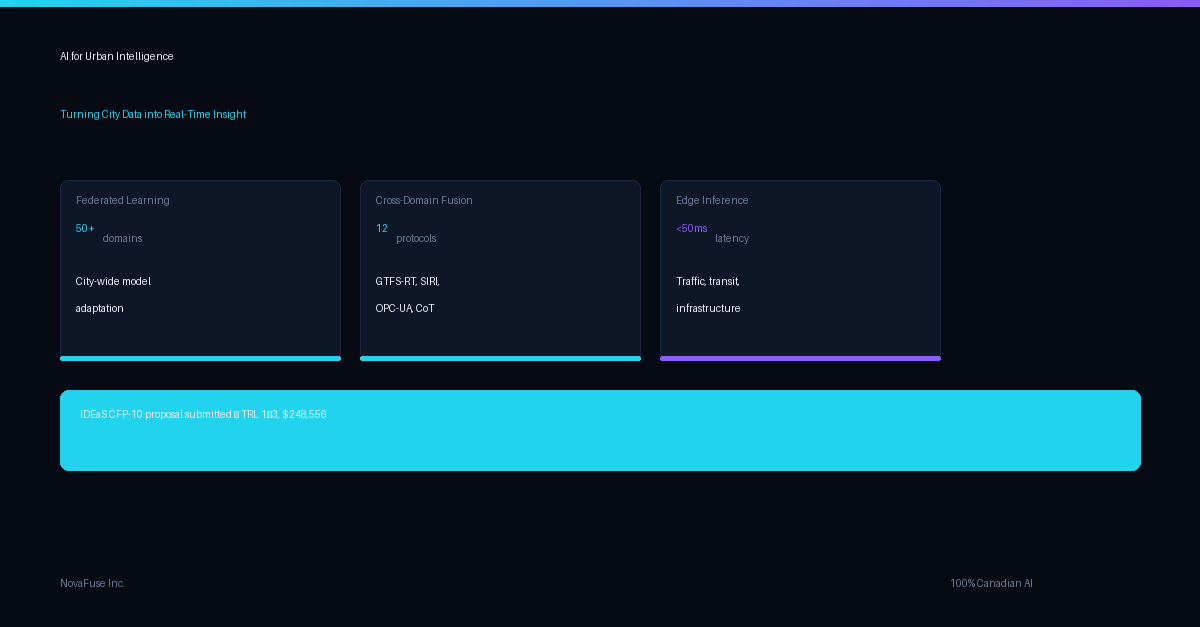
Cities are the most data-rich environments on the planet. Every traffic camera, transit card swipe, environmental sensor, utility meter, and connected vehicle generates a continuous stream of information about how the urban organism functions. Yet most of this data sits in silos — traffic management doesn't talk to emergency services, transit doesn't share with urban planning, and critical infrastructure operators see only their own domain.
The Urban Data Fragmentation Problem
A modern city produces terabytes of sensor data daily:
| Domain | Data Sources | Typical Silo |
|---|---|---|
| Transportation | Traffic cameras, loop detectors, transit GPS, ride-hail APIs, parking sensors | Traffic operations centre |
| Public Safety | 911 CAD, CCTV, gunshot detection, license plate readers | Police/fire dispatch |
| Infrastructure | SCADA (water, power, gas), bridge strain gauges, tunnel sensors | Utility operators |
| Environment | Air quality stations, weather radar, flood gauges, noise monitors | Environmental agency |
| Communications | Cell tower load, Wi-Fi probe data, mesh network telemetry | Telecom providers |
| Defence | Radar, SIGINT, UAS feeds, coalition data links | Military operations centres |
Each domain has its own ingestion pipeline, its own schema, its own visualization tools, and its own decision cycle. Cross-domain queries — "How does a power outage affect evacuation routes?" or "Where are vulnerable populations during a chemical release?" — require manual correlation that takes hours or days.
In a crisis, hours are not available.
NovaFuse's Approach: Federated Urban Intelligence
Our architecture treats the city as a distributed sensing network — exactly the same paradigm we apply to swarm operations, NORAD modernization, and Five Eyes SIGINT fusion.
Cross-Domain Multi-Modal Fusion
Rather than centralizing all data into a monolithic data lake (which creates single points of failure, privacy violations, and insurmountable schema alignment problems), our fusion engine operates federated. Each domain retains operational control of its data. Our agents connect to existing APIs, message buses, and data lakes, fusing observations at the semantic layer:
- Spatial alignment: Georegistering disparate feeds to a common reference frame
- Temporal synchronization: Aligning timestamps across systems with different clock sources
- Uncertainty quantification: Bayesian fusion that weights each source by its calibrated reliability
- Semantic translation: Ontology mapping that translates "incident" (CAD), "congestion" (traffic), and "outage" (SCADA) into a unified event taxonomy
The result: a real-time, multi-layer operational picture that updates at the speed of the fastest sensor.
Federated Learning for Urban Adaptation
Cities change. Construction alters traffic patterns. Seasons shift energy demand. New threats emerge. Static models fail.
Our federated learning layer enables continuous model adaptation across domains without raw data ever leaving its source. When the transit system's demand prediction model improves, that improvement propagates to the traffic management model — which improves evacuation planning — which improves emergency response coordination. The city learns as a collective, preserving the privacy and security boundaries that make inter-agency data sharing politically viable.
Edge-Native Real-Time Response
Urban operations demand millisecond latency. A gunshot detection system must correlate with CCTV and dispatch within seconds. A flood gauge spike must trigger traffic rerouting before intersections become impassable.
Our edge AI runtime deploys fusion and inference directly onto city infrastructure — traffic controllers, transit vehicles, pump stations, emergency vehicles. Decisions happen where the data originates, not in a remote data centre. The system functions even when cloud connectivity fails — which is exactly when urban intelligence matters most.
Defence Applications: Urban Operations in the 21st Century
The defence relevance is immediate. NATO's Urban Operations doctrine, Canada's IDEaS program, and the US Army's Dense Urban Terrain initiatives all converge on the same requirement: forces operating in cities need the same fused intelligence picture that civilian agencies use daily.
Humanitarian Assistance / Disaster Response (HADR). When CAF deploys for flood response in Winnipeg or wildfire evacuation in Kelowna, they need the city's real-time sensor picture — not a static map from last year's exercise. Federated urban intelligence gives deployed forces immediate access to live infrastructure status, population movement, and hazard tracking.
Counter-Insurgency / Stability Operations. Distinguishing hostile actors from civilian patterns of life requires fusing SIGINT, HUMINT, social media, and physical surveillance — all while respecting privacy laws and rules of engagement. Our Bayesian uncertainty quantification provides calibrated confidence, not binary alerts.
Homeland Defence. Detecting anomalous urban patterns — coordinated drone swarms, cyber-physical attacks on infrastructure, CBRN release — demands cross-domain fusion at speed. The same architecture that optimizes daily transit operations detects the anomaly that precedes an attack.
The Technical Foundation
| Layer | Function | NovaFuse Technology |
|---|---|---|
| Data Ingestion | Connect to 50+ urban data protocols | Protocol adapters (GTFS-RT, SIRI, NGSI-LD, OPC-UA, CoT, STANAG 4586) |
| Semantic Fusion | Cross-domain entity resolution | Ontology alignment + Bayesian multi-modal fusion |
| Collective Learning | City-wide model improvement | Federated learning with differential privacy |
| Edge Inference | Millisecond decision latency | WASM runtime on ARM/x86 edge nodes |
| Resilience | Operate through degradation | Mesh networking, local-first architecture |
These layers compose into the Urban Intelligence Module for our Prism platform — deployable as a SaaS service for municipalities or as an air-gapped appliance for defence customers.
Why This Matters Now
Three forces are converging:
- Sensor proliferation: Cities are deploying IoT at scale — but without fusion, the data is noise.
- Regulatory pressure: Privacy laws (PIPEDA, GDPR, provincial statutes) make centralization legally risky. Federated learning is the compliant architecture.
- Defence modernization: NORAD, NATO DIANA, and AUKUS Pillar II all identify urban operations as a capability gap. The technology that solves civilian urban intelligence solves the military problem simultaneously.
Canada has a unique position: we build the technology, we operate the cities, and we have the defence requirement. The same team that fuses sensor data for NORAD can fuse transit data for Toronto — and the lessons transfer both ways.
Conclusion
Turning urban data into real-time insight isn't a smart city buzzword. It's a strategic capability for resilience, for public safety, and for defence. The city that sees itself clearly — across domains, in real time, with quantified uncertainty — makes better decisions in crisis and in daily operations.
NovaFuse's federated multi-modal fusion architecture provides the technical foundation. The IDEaS challenge validates the requirement. The only question is which Canadian cities — and which allied forces — deploy it first.
About NovaFuse
NovaFuse Inc. builds multi-modal AI fusion systems for defence and critical infrastructure. Our platform, Prism, integrates heterogeneous sensor data with uncertainty quantification, federated learning, and edge deployment — purpose-built for NORAD modernization, coalition operations, and Canadian sovereign AI requirements.