AI for Arctic Surveillance - NORAD's Most Complex Problem
June 12, 2026 - Multi-Modal Sensor Fusion - Edge AI - Arctic Defence - NORAD
← Previous: Secure Information Sharing for Coalition OperationsThe Arctic Problem
Canada's Arctic spans 4 million square kilometres. The Northwest Passage is becoming navigable. Russian long-range aviation patrols are increasing. Chinese research vessels are appearing in waters they have never visited before. And NORAD - the binational command responsible for aerospace warning and maritime warning across North America - must detect, track, and identify every one of these threats across the largest and harshest surveillance domain on Earth.
The challenge is not just scale. It is that the Arctic breaks most assumptions that modern AI systems depend on: connectivity is unreliable, sensors fail in extreme cold, and the cost of a false negative - a threat that goes undetected - is measured in national security, not dollars.
This is the problem that keeps NORAD planners awake at night. And it is the problem that NovaFuse's technology stack was built to solve.
Why the Arctic Breaks Conventional AI
Most AI systems are designed for environments with stable infrastructure: reliable power, high-bandwidth connectivity, temperate operating conditions. The Arctic violates every one of these assumptions.
Connectivity: Satellite coverage at high latitudes is intermittent. Bandwidth is limited. A surveillance system that depends on sending raw sensor data to a cloud data centre will fail precisely when it is needed most.
Sensor performance: Radar returns behave differently over ice and snow. Electro-optical sensors struggle with whiteout conditions and months of darkness. Acoustic sensors perform differently in extreme cold. Every sensor modality has failure modes that are unique to the Arctic environment.
Data scarcity: The Arctic is vast and sparsely monitored. There simply is not the volume of historical training data that AI systems typically require. Models trained on temperate-environment data will underperform when deployed north of the 60th parallel.
Adversarial conditions: Adversaries operating in the Arctic know that surveillance is difficult. They exploit the gaps - using weather as cover, operating during communication blackouts, employing low-observable technologies designed to defeat specific sensor types.
The Multi-Modal Imperative
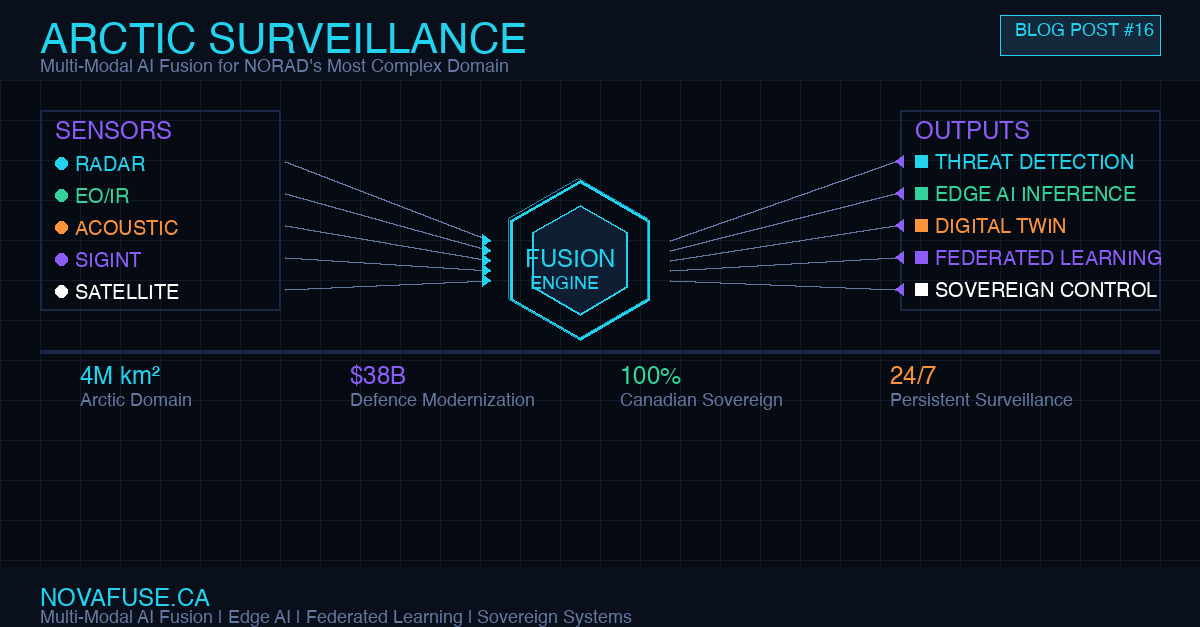
No single sensor can solve the Arctic surveillance problem. The solution requires fusing data from multiple modalities - radar, electro-optical/infrared, acoustic, signals intelligence, and satellite-based systems - into a unified operational picture.
As we discussed in Blog Post #9, multi-modal fusion is fundamentally about compensating for the weaknesses of any single sensor with the strengths of others. In the Arctic, this is not just a performance optimization - it is a survivability requirement.
The key technical challenge is that Arctic conditions create correlated failure modes. When a blizzard degrades electro-optical sensors, it may also affect acoustic propagation and increase radar clutter from blowing snow. A fusion system that assumes independent sensor failures will overestimate its own reliability.
Edge AI for the Arctic Edge
The connectivity constraints of the Arctic make edge AI not just desirable but essential. Processing sensor data at the point of collection eliminates the dependency on communication links that may not exist.
As we explored in Blog Post #4, edge AI for defence means optimizing for size, weight, power, and cost while maintaining the accuracy needed for safety-critical decisions. NovaFuse's edge AI architecture uses model compression techniques to deploy high-performance fusion models on ruggedized edge hardware.
Digital Twins for Arctic Readiness
One of the most promising applications of AI to Arctic surveillance is the digital twin - a virtual replica of the physical surveillance environment for planning, training, and real-time decision support.
As we described in Blog Post #11, a digital twin of the Arctic surveillance domain integrates real-time sensor data with environmental models, threat databases, and historical patterns. For NORAD, this enables predictive gap analysis, sensor placement optimization, and model validation against synthetic Arctic conditions.
Federated Learning Across the Northern Frontier
The vast distances and limited connectivity of the Arctic create a natural use case for federated learning. Multiple surveillance sites can each train local models on their own data, then share model updates - not raw data - to create a collective model.
As we covered in Blog Post #8, federated learning is particularly valuable when data cannot be centralized. The result is a surveillance AI that learns from the entire northern frontier without requiring any site to transmit raw sensor data over vulnerable links.
The Sovereignty Dimension
Arctic surveillance is fundamentally a sovereignty issue. As climate change opens new shipping routes and resource extraction opportunities, the ability to monitor and control activity in Canada's northern waters and airspace becomes a core national security function.
As we argued in Blog Post #7, Canada cannot rely on foreign AI systems for its most sensitive surveillance missions. NovaFuse's Arctic surveillance stack is designed from the ground up as a sovereign Canadian solution.
The NORAD Modernization Connection
NORAD modernization is the single largest defence procurement priority in Canada. The Government of Canada has committed over $38 billion to continental defence modernization over the next 20 years, with Arctic surveillance as a central component.
AI-enabled Arctic surveillance is not a futuristic concept. It is a current operational requirement. The companies that can demonstrate working solutions today will be the ones that shape the architecture of continental defence for decades to come.
Conclusion
The Arctic is Canada's most challenging surveillance domain and its most important sovereignty frontier. The vast distances, extreme conditions, and limited infrastructure break conventional AI approaches. But they also create the conditions where NovaFuse's technology stack delivers its greatest advantage.
The question is not whether AI will transform Arctic surveillance. It is which companies will build the systems that protect Canada's north. NovaFuse is ready.
Learn more about NovaFuse's capabilities: