AI for CBRN Detection and Response — Multi-Modal Fusion for the Deadliest Threats
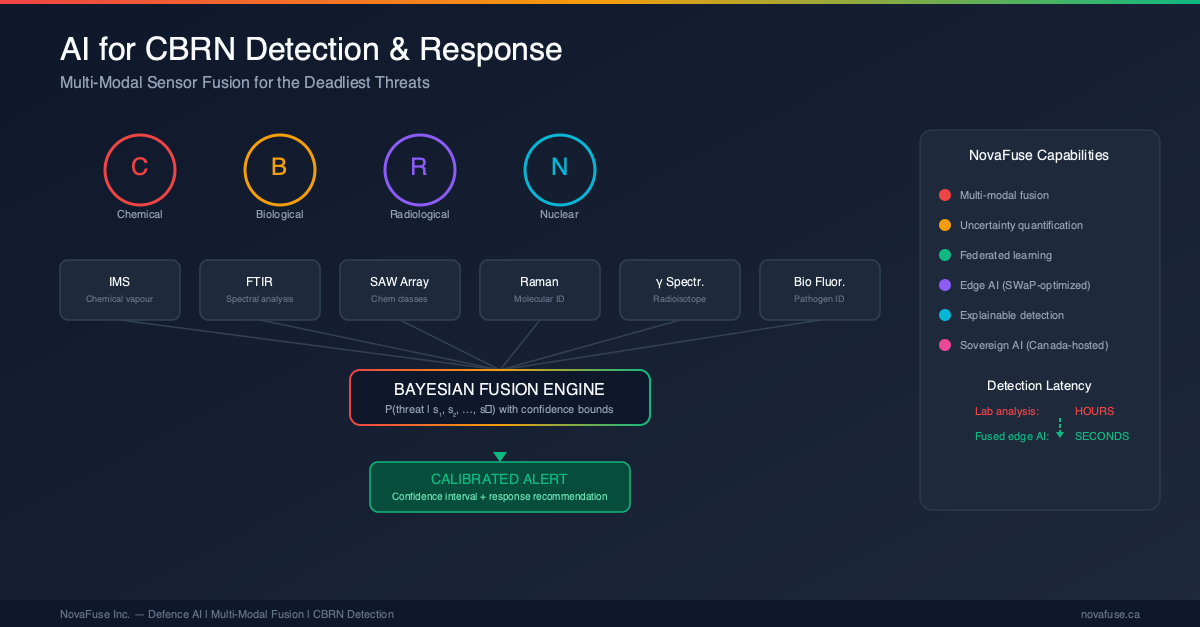
Chemical, biological, radiological, and nuclear (CBRN) threats demand detection systems that are fast, reliable, and resilient. Multi-modal sensor fusion combined with edge AI is transforming how defence forces detect, classify, and respond to the most dangerous substances on the battlefield.
The CBRN Detection Problem
CBRN threats occupy a unique position in defence: they are low-probability but catastrophic-impact events where detection speed and accuracy directly determine survival. Current systems face three fundamental challenges:
| Challenge | Impact | Current Limitation |
|---|---|---|
| Signal ambiguity | Chemical agents produce overlapping spectral signatures; biological agents evolve | Single-sensor false alarm rates of 30–60% |
| Environmental interference | Urban dust, humidity, industrial chemicals mask threat signatures | Degraded performance in real-world conditions vs. lab settings |
| Decision latency | Confirmation requires lab analysis (hours to days) | Forces choose between false alarms (operationally costly) or delayed response (lethally costly) |
The 2018 Novichok incident in Salisbury demonstrated these limits: initial detection was ambiguous, environmental contamination was widespread, and the response required days of laboratory confirmation. In a tactical scenario, that latency is unacceptable.
Multi-Modal Fusion for CBRN: The Architecture
NovaFuse's approach applies multi-modal sensor fusion at the edge to collapse detection timelines from hours to seconds while maintaining the confidence thresholds that defence requires.
Sensor Modalities for CBRN Detection
| Sensor Type | Detects | Strength | Weakness |
|---|---|---|---|
| Ion mobility spectrometry (IMS) | Chemical vapours | Fast (seconds), portable | Limited specificity, drift |
| Fourier-transform infrared (FTIR) | Chemical functional groups | High specificity | Requires line of sight, moisture-sensitive |
| Surface acoustic wave (SAW) | Chemical classes | Low power, array-capable | Broad category only |
| Fluorescence spectroscopy | Biological agents | Sensitive to bio-markers | Background fluorescence interference |
| Raman spectroscopy | Molecular fingerprints | Non-destructive, specific | Weak signal, requires enhancement |
| Gamma spectrometry | Radiological/nuclear | Definitive for radioisotopes | Heavy, power-hungry |
| Environmental sensors | Context | Disambiguates false positives | Not a threat detector alone |
No single modality is sufficient. Fusion is not optional for CBRN — it is the architecture.
Key Technical Advances
1. Bayesian Multi-Modal Integration
Rather than simple voting or weighted averaging, the fusion engine computes the full posterior probability of a CBRN threat given all sensor observations:
P(threat | s₁, s₂, ..., sₖ) = P(s₁, s₂, ..., sₖ | threat) × P(threat) / P(s₁, s₂, ..., sₖ)This matters because each sensor has a different false positive profile — IMS flags cleaning solvents, FTIR flags industrial emissions — and conditional dependencies between sensors must be modelled. Prior probabilities shift based on context (near chemical plant vs. open field vs. urban area).
2. Uncertainty Quantification as a Force Multiplier
For CBRN, a point estimate is insufficient. Decision-makers need to know confidence bounds, what sensor data is still missing, and where models disagree. NovaFuse's uncertainty quantification framework surfaces all three, enabling commanders to make risk-aware decisions rather than acting on opaque confidence scores.
3. Federated Learning Across Detection Networks
CBRN threat libraries are classified and compartmentalized. Federated learning enables model improvement without sharing raw classified data, cross-coalition calibration (UK Porton Down models inform Canadian DRDC models), and continuous adaptation to novel agents — critical for biological threats that evolve.
4. Edge Deployment Under SWaP Constraints
| Platform | Power Budget | Compute | Latency Req. |
|---|---|---|---|
| Man-pack | < 20W | ARM SoC, 4 TOPS | < 5 seconds |
| Vehicle-mounted | < 200W | GPU edge, 30 TOPS | < 2 seconds |
| Fixed sensor network | Mains power | Server-class | < 10 seconds (batch) |
NovaFuse's split architecture trains fusion models in the cloud and deploys optimized inference graphs to edge hardware — maintaining accuracy while fitting within platform constraints.
NORAD and Allied Relevance
| Mission | CBRN Fusion Application |
|---|---|
| Aerospace warning | Detect CBRN signatures from aircraft/missile plumes |
| Maritime domain awareness | Monitor shipping for chemical/biological smuggling |
| Arctic sovereignty | Detect radiological events in remote sensing data |
| Civil defence | Urban CBRN monitoring for major events |
| Coalition operations | Federated threat libraries across Five Eyes / NATO |
The NATO CBRN Defence Centre of Excellence has identified AI-enabled detection as a priority capability gap. Canada's DRDC Suffield is actively researching AI-augmented CBRN detection — a potential NovaFuse partner.
The NovaFuse Advantage
| Capability | CBRN Application |
|---|---|
| Multi-modal fusion | Integrate 5+ sensor modalities with Bayesian confidence |
| Uncertainty quantification | Decision-grade confidence intervals, not just scores |
| Federated learning | Cross-coalition model improvement without data sharing |
| Edge AI | Man-pack to vehicle deployment with SWaP optimization |
| Explainable AI | Audit trails for each detection (regulatory / legal requirements) |
| Sovereign AI | Canadian-hosted, classified-capable infrastructure |
CBRN detection is where NovaFuse's core capabilities converge into a mission-critical application. The technology exists today — what's needed is the fusion architecture that makes it reliable, explainable, and deployable at the tactical edge.
About NovaFuse
NovaFuse Inc. builds multi-modal AI fusion systems for defence and critical infrastructure. Our platform, Prism, integrates heterogeneous sensor data with uncertainty quantification, federated learning, and edge deployment — purpose-built for NORAD modernization, coalition operations, and Canadian sovereign AI requirements.