AI for Cognitive Warfare — Defending the Information Domain
June 21, 2026 — Cognitive Warfare — Disinformation Detection — Deepfake Identification — Information Operations — NATO — Five Eyes
Introduction
The battlefield is no longer limited to land, sea, air, space, and cyberspace. Defence analysts have added a sixth domain: the cognitive domain — the space where perceptions are shaped, decisions are made, and populations are influenced.
State-sponsored disinformation campaigns, deepfake propaganda, and AI-generated social media manipulation now represent a tier of threat that traditional military capabilities cannot address. Russia's documented information operations against Ukraine, China's influence campaigns targeting democratic elections, and the explosion of AI-generated synthetic media have made cognitive warfare a first-order national security concern.
For Canada, the challenge is acute. As a Five Eyes member and NATO ally, Canada is both a target and a potential hub for allied counter-disinformation capability. The Canadian Security Establishment (CSE) has identified foreign information manipulation as a persistent threat to democratic institutions. The Canadian Armed Forces need AI systems that can detect, attribute, and counter cognitive threats at machine speed — because the adversary already operates at that speed.
What Is Cognitive Warfare?
Cognitive warfare is the use of information and influence operations to modify perceptions, undermine trust, and manipulate decision-making in target populations. Unlike traditional propaganda, cognitive warfare leverages AI to personalize, scale, and adapt in real time.
The tools of cognitive warfare include:
- Synthetic media: AI-generated text, images, audio, and video that fabricate events, statements, or evidence that never occurred.
- Coordinated inauthentic behaviour: Networks of AI-managed social media accounts that amplify divisive narratives, suppress opposing views, and create artificial consensus.
- Narrative laundering: The process of seeding disinformation through seemingly independent sources — blogs, forums, local media — until it appears to have organic credibility.
- Targeted micro-propaganda: AI-personalized messaging delivered to specific demographic segments based on psychographic profiling.
Why AI Is Both the Problem and the Solution
The same AI capabilities that enable cognitive warfare also provide the most promising countermeasures.
The problem side: Large language models can generate persuasive disinformation at scale — thousands of unique, contextually appropriate articles, social media posts, or comments per hour. Generative adversarial networks produce deepfakes that are increasingly indistinguishable from authentic media. Reinforcement learning agents can optimize influence campaigns by testing thousands of narrative variants and amplifying the most effective ones. The solution side: AI can detect synthetic media through artifact analysis, identify coordinated inauthentic behaviour through network graph analysis, trace narrative propagation across platforms, and provide real-time situational awareness of the information environment.The asymmetry favours detection. Generating convincing disinformation requires creativity and context. Detecting it requires pattern recognition at scale — which is precisely what AI does best.
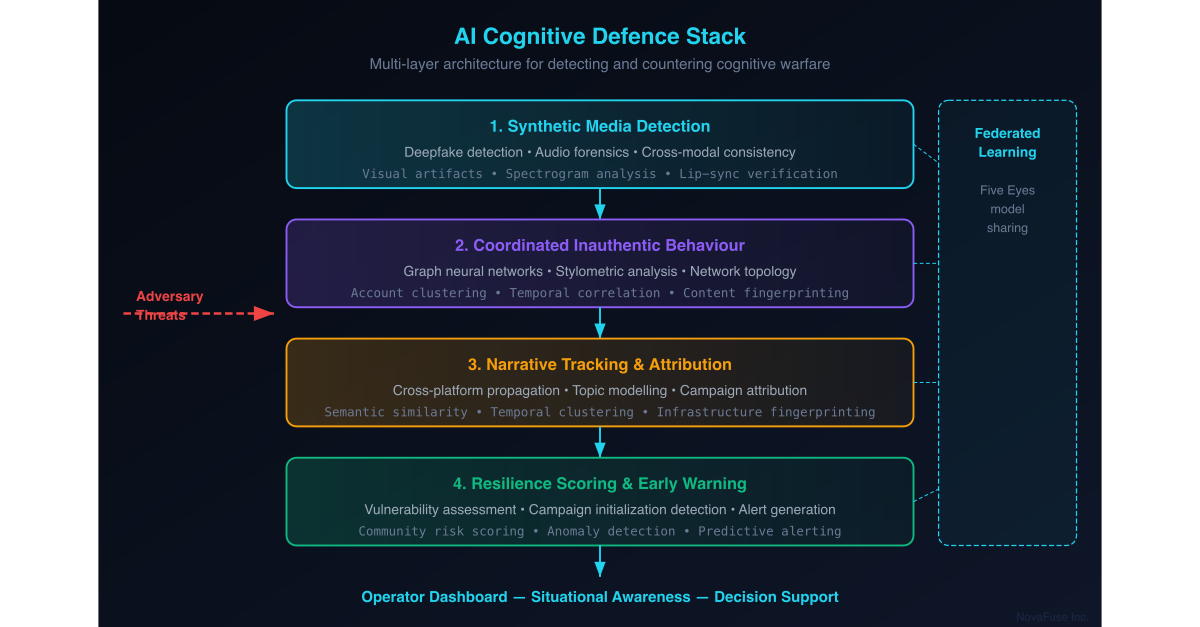
The AI Cognitive Defence Stack
1. Synthetic Media Detection
Deepfake detection has evolved from simple visual artifact analysis to multi-modal forensic systems that examine inconsistencies across video, audio, and text simultaneously.
Visual analysis detects subtle artifacts in synthetic video — inconsistent lighting, unnatural eye movement, boundary artifacts around faces, and temporal inconsistencies between frames. Convolutional neural networks trained on large datasets of authentic and synthetic video can identify deepfakes with accuracy exceeding 95% for current generation models. Audio analysis examines spectrograms for signs of synthetic speech generation — unnatural formant transitions, consistent background noise patterns, and spectral artifacts characteristic of text-to-speech and voice conversion systems. Cross-modal consistency checks whether the audio, video, and text channels of a piece of media are mutually consistent. A deepfake video may have convincing visuals and convincing audio independently, but subtle asynchronies between lip movement and speech, or between described events and visual content, reveal manipulation.The challenge is that detection must evolve as fast as generation. As generative models improve, the artifacts that detection systems rely on become subtler. Continuous adversarial training — where detection models are regularly retrained against the latest generation models — is essential.
2. Coordinated Inauthentic Behaviour Detection
State-sponsored influence operations rarely rely on a single account. They deploy coordinated networks — sometimes thousands of accounts — that work together to amplify narratives, attack critics, and create the illusion of grassroots support.
AI detects these networks through graph neural networks that analyse social media interaction patterns. Coordinated networks exhibit structural signatures that organic communities do not: synchronized posting times, unusual follower overlap, repetitive content sharing patterns, and communication topologies that suggest central coordination.
Natural language analysis adds another layer. Accounts in a coordinated network may use similar phrasing, share identical text passages, or exhibit linguistic patterns consistent with a single author or translation pipeline. Stylometric analysis — the AI equivalent of forensic handwriting comparison — can link accounts based on writing style alone.
For Five Eyes allies, federated detection models offer the same advantage as federated EW intelligence: each nation analyses its own social media ecosystem, and model updates — not raw intelligence — are shared. This enables collective detection of cross-border influence campaigns without exposing domestic surveillance capabilities.
3. Narrative Tracking and Attribution
Cognitive warfare campaigns follow predictable lifecycle patterns: a narrative is created, seeded through fringe channels, amplified by coordinated networks, picked up by mainstream sources, and eventually becomes part of the accepted information environment.
AI systems can track narratives across platforms and languages, identifying the same story as it evolves from a fringe blog post to a mainstream news item. Topic modelling, semantic similarity analysis, and temporal clustering reveal the propagation pathways that human analysts cannot track at scale.
Attribution — determining who is behind a campaign — combines technical indicators (infrastructure fingerprints, account registration patterns, operational security mistakes) with content analysis (language patterns, narrative alignment with known state interests, timing relative to geopolitical events). AI does not replace human judgement in attribution, but it dramatically narrows the search space.
4. Resilience Scoring and Early Warning
The most valuable cognitive defence capability is not detecting individual pieces of disinformation — it is identifying when a coordinated campaign is beginning, before it achieves critical mass.
AI early warning systems monitor the information environment for the signatures of campaign initialization: sudden increases in coordinated account activity, the appearance of new narrative themes aligned with adversary interests, and the seeding of content in channels that historically serve as campaign launchpads.
Resilience scoring assesses the vulnerability of specific communities, institutions, or information ecosystems to cognitive attack. Communities with low media literacy, high polarization, or limited access to trusted information sources are more susceptible. AI models can identify at-risk populations and inform targeted resilience-building interventions — a defensive application that aligns with CSE's mandate to protect democratic institutions.
The Canadian Opportunity
Canada is well-positioned to become a leader in AI-driven cognitive defence.
Multilingual capability. Canada's bilingual (English-French) requirement means Canadian AI systems must handle multiple languages natively — a direct advantage in the Five Eyes context, where allies need to monitor information environments in dozens of languages. Allied trust. Canada's position as a trusted Five Eyes partner makes it a natural host for federated cognitive defence models. Canadian-developed frameworks for cross-border disinformation detection — with appropriate privacy and civil liberties safeguards — would strengthen the entire alliance. Academic strength. Canadian universities are leaders in natural language processing, graph neural networks, and adversarial machine learning — the core technical capabilities underlying cognitive defence AI. Partnerships between DND, CSE, and Canadian academic institutions could accelerate development while building the talent pipeline that both defence and industry need. Sovereign necessity. As cognitive warfare targets democratic institutions directly, reliance on foreign AI systems for information environment awareness creates the same strategic vulnerability as foreign dependence in any other defence domain. Canada needs sovereign cognitive defence capability.Challenges and Considerations
AI cognitive defence raises important considerations that must be addressed carefully.
Civil liberties. Monitoring the information environment for disinformation campaigns inevitably involves analysing public communication at scale. Robust legal frameworks, independent oversight, and strict limitations on domestic surveillance are essential. The goal is to detect foreign influence operations — not to monitor Canadian citizens' speech. Adversarial adaptation. State-sponsored actors will adapt their techniques to evade detection. AI systems must be designed for continuous adversarial evolution, not static deployment. Red team exercises, where dedicated teams attempt to fool detection systems, are essential for maintaining effectiveness. Attribution uncertainty. AI can identify patterns consistent with state-sponsored campaigns, but definitive attribution requires human judgement and intelligence context. Over-reliance on automated attribution risks false accusations that could escalate geopolitical tensions. Speed vs. accuracy. In cognitive warfare, a disinformation campaign can achieve its objectives within hours. Detection systems must operate at machine speed, but false positives — incorrectly flagging authentic content as disinformation — can undermine trust in the system itself. Calibrated uncertainty, where the system reports confidence levels rather than binary decisions, is essential.Conclusion
Cognitive warfare is not a future threat — it is a current operational reality. State-sponsored actors are using AI to manipulate information environments, undermine democratic institutions, and erode the trust that societies require to function.
Canada has the technical capability, allied relationships, and strategic necessity to become a leader in AI-driven cognitive defence. The same multi-modal AI architectures — federated learning, graph neural networks, cross-modal consistency analysis — that NovaFuse is developing for sensor fusion and electronic warfare apply directly to the information domain.
The cognitive battlefield is invisible, but it is not undefendable. AI provides the detection, tracking, and early warning capabilities that democratic societies need to protect their information environment. The question is not whether to deploy these capabilities, but whether we will do so before the next major influence campaign achieves its objectives.
NovaFuse is researching AI architectures for multi-domain defence applications, including cognitive defence capabilities. For information about our work or to discuss partnership opportunities, contact info@novafuse.ca.
NovaFuse Inc. is an Ontario-based Canadian AI company specializing in multi-modal sensor fusion, federated learning, and edge AI for defence applications. 100% Canadian-owned, 100% Canadian content.
Learn more about NovaFuse's capabilities: