AI for Counter-UAS — Detecting and Responding to the Drone Threat
Introduction
In March 2026, the IDEaS program issued a challenge call that reflects a growing reality for the Canadian Armed Forces: "Sentinel Shield — Wide-area detection for early warning against uncrewed aerial systems." The challenge seeks solutions capable of persistent, wide-area detection, recognition, identification, and tracking of Class I and II Uncrewed Aerial Systems (UAS).
The drone threat is no longer theoretical. From the conflict zones of Eastern Europe to the Arctic approaches of North America, small commercial drones have been adapted for reconnaissance, targeting, and even kinetic attack. Defending against them requires a fundamentally different approach than traditional air defence.
This is the counter-UAS problem — and it's one of the hardest challenges in modern defence AI.
Why Counter-UAS Is Different
Traditional air defence was designed for fast, high-altitude targets with large radar cross-sections. Fighter jets, cruise missiles, and ballistic missiles all present relatively clear signatures to radar and infrared sensors.
Small drones break every assumption:
- Tiny radar cross-sections: A Class I drone (under 15 kg) has a radar signature comparable to a large bird. Traditional air defence radars filter these out as clutter.
- Low altitude: Small drones fly below the coverage floor of many legacy radar systems.
- Slow speed: A drone hovering at 100 metres can look identical to a stationary object on radar.
- Swarm tactics: A single operator can deploy dozens of drones simultaneously, overwhelming sequential engagement systems.
- Commercial availability: The same DJI platform used by a wedding photographer can be adapted for military reconnaissance in hours.
The Sensor Fusion Challenge
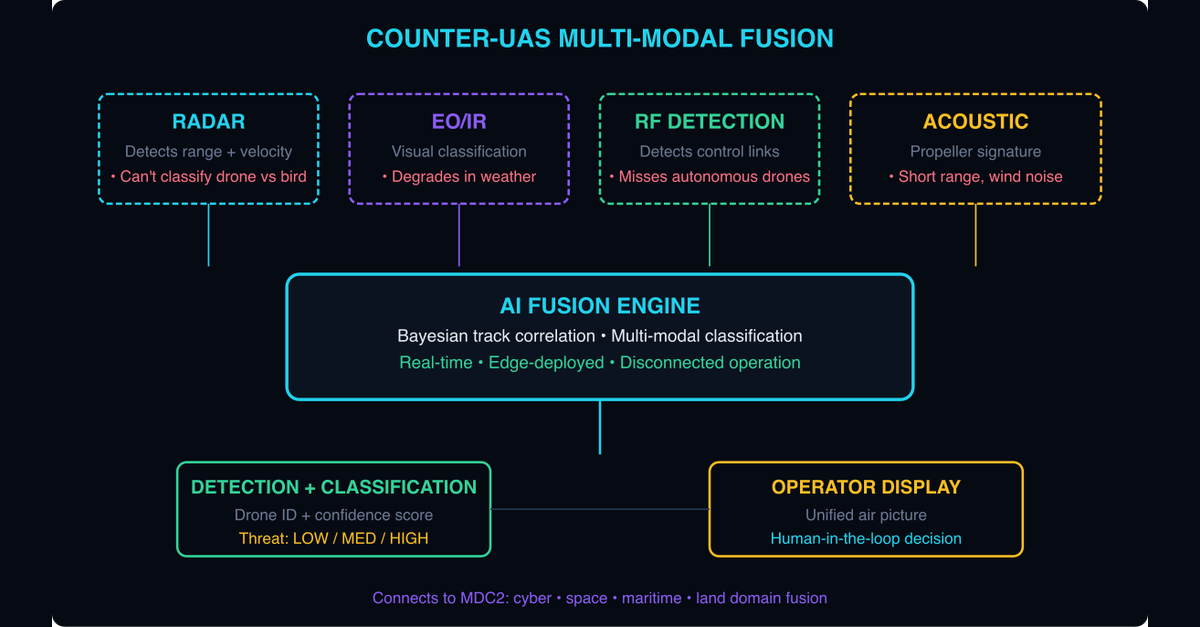
No single sensor can reliably detect, classify, and track small drones in all conditions. The solution requires fusing multiple sensor modalities — each with complementary strengths and weaknesses:
Radar
Modern counter-UAS radars operate at higher frequencies (X-band and above) to detect small, slow targets. They provide precise range and velocity data but struggle with classification — a drone, a bird, and a tumbling plastic bag can look identical on radar.
Electro-Optical / Infrared (EO/IR)
Cameras provide rich visual data for classification and identification. A thermal camera can distinguish a drone's motor heat signature from a bird's body heat. But cameras require line of sight, degrade in poor weather, and have limited range against small targets.
Radio Frequency (RF) Detection
Most drones communicate with their operators via radio link. RF sensors can detect and geolocate these signals, providing early warning before the drone is visually or radar-detectable. But autonomous drones with pre-programmed routes emit no RF signal.
Acoustic Sensors
The distinctive acoustic signature of drone propellers can be detected and classified by microphone arrays. Acoustic sensors work in complete darkness and don't require line of sight, but have limited range and are affected by wind and ambient noise.
The Fusion Imperative
Each sensor alone provides an incomplete picture. Radar detects but can't classify. Cameras classify but can't see through clouds. RF detects but misses autonomous drones. Acoustics work in the dark but have short range.
The only reliable approach is multi-modal fusion — combining all these sensor streams into a single, coherent air picture where each sensor compensates for the others' weaknesses.
The AI Layer
Sensor fusion for counter-UAS isn't just about combining data. It's about making real-time decisions under uncertainty with potentially dozens of simultaneous tracks.
Detection and Classification
The first challenge is distinguishing drones from clutter. Birds, debris, weather phenomena, and ground vehicles all produce signatures that can mimic small drones. AI models trained on multi-modal data — radar micro-Doppler signatures, thermal profiles, acoustic patterns, and RF emissions — can achieve classification accuracies above 95% in controlled conditions.
But controlled conditions don't exist in the field. A Canadian Arctic surveillance post faces temperatures of -40°C, 60 km/h winds, and months of darkness. AI models must be robust to these extremes.
Track Correlation
When multiple sensors detect the same drone, the system must determine that they're seeing the same object. This is harder than it sounds — different sensors have different update rates, different accuracy levels, and different coordinate systems. A radar update at 10 Hz must be correlated with a camera frame at 30 Hz and an RF bearing at 1 Hz.
Bayesian track correlation — the same mathematical framework used in uncertainty quantification (Blog #12) — provides a principled way to fuse these asynchronous, heterogeneous data streams.
Threat Assessment
Not every drone is a threat. A commercial drone flying a pre-approved route near an airport is different from an unidentified drone approaching a military installation. The AI must assess intent based on flight profile, origin, and behaviour — and communicate its assessment with appropriate confidence levels to the operator.
The Edge Dimension
Counter-UAS systems must operate at the tactical edge — on forward operating bases, mobile platforms, and remote Arctic sites. This creates the same constraints we discussed in our Edge AI post (Blog #4):
- Disconnected operations: No cloud connectivity. All processing must happen locally.
- SWaP constraints: Limited size, weight, and power on mobile platforms.
- Real-time requirements: A drone travelling at 50 m/s covers 50 metres every second. Detection-to-decision latency must be measured in seconds, not minutes.
Connecting to the MDC2 Vision
Counter-UAS isn't just an air defence problem. In the Multi-Domain Command and Control framework (Blog #13), drone threats must be correlated with:
- Cyber domain: Was the drone's command link spoofed or jammed? Is there a coordinated cyber attack enabling the drone incursion?
- Space domain: Are satellite communications being used to control the drone beyond line of sight?
- Maritime domain: Is the drone launched from a surface vessel approaching Canadian waters?
The Canadian Context
Canada's counter-UAS challenge is unique. The country's vast territory — particularly the Arctic — creates surveillance gaps that adversaries can exploit. NORAD modernization (Blog #9) includes specific provisions for detecting low, slow, small (LSSS) targets across the northern approaches.
The IDEaS "Sentinel Shield" challenge is a direct response to this need. It calls for wide-area detection capabilities that can provide early warning against Class I and II UAS — exactly the kind of small, commercially available drones that pose the most immediate threat.
For Canadian defence AI companies, counter-UAS represents both a near-term opportunity and a strategic differentiator. The ability to detect and classify small drones in Canadian operating conditions — Arctic cold, northern lights interference, vast distances — is a capability that matters to Canada's allies as well.
Conclusion
The counter-UAS problem is a microcosm of modern defence AI: multiple imperfect sensors, real-time fusion requirements, edge deployment constraints, and the need for transparent, trustworthy decision-making.
It's also a problem that's getting worse. Drone technology is advancing faster than counter-drone technology. The gap between what a $500 commercial drone can do and what a $5M air defence system can detect is growing, not closing.
Closing that gap requires the kind of multi-modal, AI-driven sensor fusion that NovaFuse has built its platform around. From detection to classification to threat assessment, the counter-UAS mission demands exactly the capabilities that our fusion engine, edge AI architecture, and uncertainty quantification framework provide.
The drones are coming. The question is whether we'll see them in time.
---
About NovaFuse: NovaFuse is an Ontario-based AI company specializing in multi-modal sensor fusion, federated learning, and edge AI for defence applications. We are an IDEaS CFP-006 applicant and active participant in the Canadian defence innovation ecosystem.
Learn more about NovaFuse's capabilities: