AI for Military Simulation & Wargaming — From Map Tables to Digital Battlefields
June 24, 2026 — Military Simulation — Wargaming — Digital Twins — Decision Support — NATO Training — Defence Modernization
Introduction
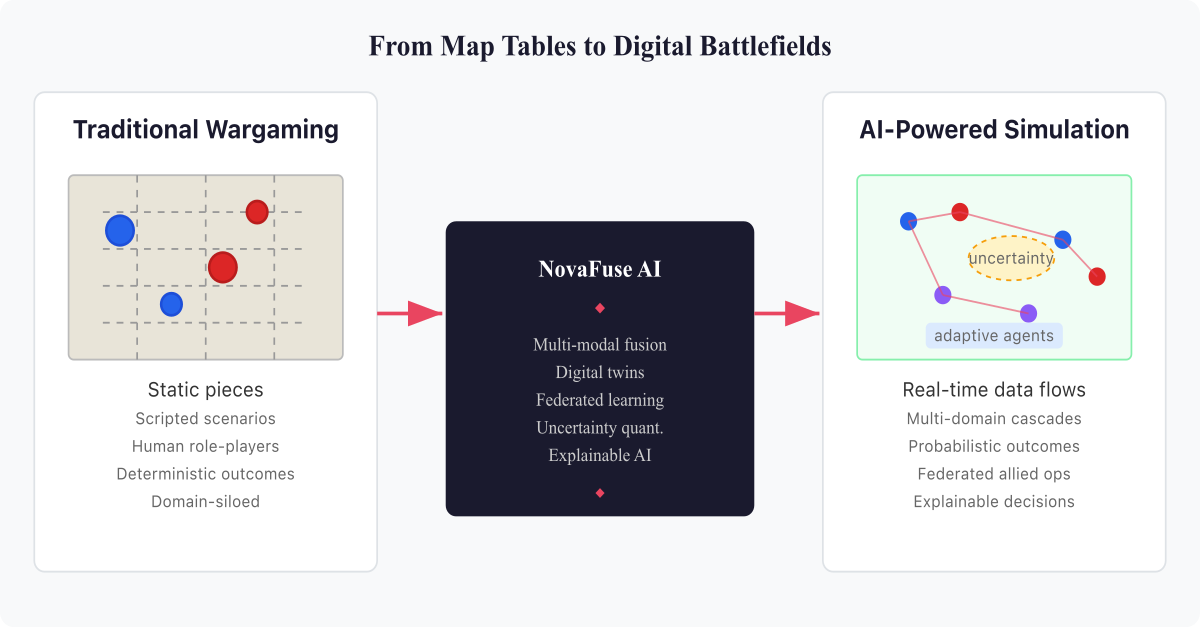
Military wargaming has evolved from sand tables and hex-board maps to AI-driven simulations that can model entire theatres of conflict in real time. From Prussian Kriegsspiel to today's AI-powered constructive simulations, the goal has always been the same: prepare commanders for decisions they hope never to face. But the gap between traditional wargaming and the complexity of modern multi-domain operations has become a chasm — and AI is the bridge.
Canada's defence modernization demands simulation capabilities that can keep pace with the speed and complexity of near-peer conflict. The CAF needs wargaming tools that don't just replay historical scenarios but generate adaptive, AI-driven adversaries, model cascading effects across domains, and provide commanders with real-time decision support rooted in uncertainty quantification. For NovaFuse, this is where our multi-modal fusion, digital twin, and federated learning stack converges into a single high-value capability.
The Simulation Gap in Modern Defence
Traditional military simulation relies on scripted scenarios, deterministic outcomes, and human role-players acting as opposing forces. This approach has three critical limitations:
- Static adversaries: Pre-scripted opponents cannot adapt to novel tactics, making them poor proxies for near-peer adversaries who learn and innovate.
- Domain silos: Land, air, maritime, space, and cyber simulations rarely interact dynamically — yet modern conflict is inherently multi-domain.
- No uncertainty modelling: Deterministic simulations give commanders false confidence. Real operations are defined by incomplete information, sensor failures, and fog of war.
AI addresses all three gaps. Machine learning agents can serve as adaptive adversaries that evolve strategies in response to player actions. Multi-domain simulations can model cross-domain cascading effects — a cyber attack disabling communications, degrading sensor fusion, creating openings for a kinetic strike. And probabilistic AI systems can inject calibrated uncertainty into every decision point, forcing commanders to operate in realistic information environments.
What AI Brings to Wargaming
Adaptive Opposing Forces
Modern reinforcement learning (RL) agents can learn to play complex strategy games at superhuman levels. In military simulation, this translates to opposing force (OPFOR) units that adapt their tactics based on observed player behaviour. Instead of following pre-scripted decision trees, AI OPFOR identifies patterns, exploits weaknesses, and innovates — just as a real adversary would.
Key requirements include:
- Hierarchical RL: Agents must operate at strategic, operational, and tactical levels simultaneously.
- Realistic constraints: AI OPFOR must obey the same doctrinal, logistical, and rules-of-engagement constraints as real forces.
- Explainability: Commanders need to understand WHY the AI made a specific decision — black-box adversaries are poor training tools.
Multi-Domain Cascade Modelling
AI-powered simulations can model how actions in one domain create effects in another. A successful electronic warfare strike against an enemy radar network degrades their air defence picture, creating a window for an air strike, which triggers a kinetic response, which escalates the conflict — all modelled in real time with probabilistic outcomes.
This requires:
- Digital twin integration: Real-time sensor feeds and digital twin models of physical systems feed the simulation with current state data.
- Graph-based causality: AI models that represent cause-and-effect relationships across domains, enabling realistic cascade chains.
- Monte Carlo simulation: Running thousands of probabilistic scenarios to identify the most likely outcomes and the key decision points that influence them.
Decision Support Under Uncertainty
The most valuable AI capability in wargaming isn't simulation — it's decision support. AI systems that can ingest real-time sensor data, assess the current situation, generate courses of action, and quantify the uncertainty around each option give commanders a decisive edge.
This connects directly to NovaFuse's work on uncertainty quantification for defence. Bayesian AI models don't just give answers — they tell you how confident you should be in those answers. In a wargaming context, this means:
- Probabilistic course-of-action analysis: “Option A has a 60% chance of achieving the objective with acceptable casualties, but a 15% risk of escalation.”
- Sensor gap identification: “Your picture of the maritime domain is 40% incomplete — here's where you need additional ISR assets.”
- Adversary intent estimation: “Based on observed patterns, there's a 70% probability the adversary is preparing a flanking manoeuvre within 6 hours.”
From Map Tables to Digital Battlefields
Canada's Simulation Landscape
Canada has significant but underconnected simulation capabilities:
- CAF Wargaming Centre (CFB Kingston): The CAF's primary wargaming facility, focused on constructive and tabletop exercises.
- DRDC centres: Research in modelling and simulation across Toronto, Ottawa, Valcartier, and Atlantic regions — but often siloed by domain.
- Maple Resolve: The CAF's largest annual exercise, increasingly incorporating simulation and synthetic environments.
- NATO simulation centres: Multiple NATO allies maintain advanced simulation capabilities that Canada could contribute to and learn from.
The gap is integration. No single Canadian system connects real-time sensor data, multi-domain modelling, AI-driven adversaries, and uncertainty quantification into a unified wargaming environment. This is exactly the gap NovaFuse's technology stack is designed to fill.
NovaFuse's Approach: The Simulation Prism
NovaFuse's platform architecture maps directly onto next-generation simulation requirements:
| Capability | NovaFuse Technology | Simulation Application |
|---|---|---|
| Multi-modal sensor fusion | Real-time data integration from heterogeneous sources | Live sensor feeds into simulation environment |
| Digital twin modelling | Physics-informed AI models of physical systems | Realistic representation of platforms, terrain, effects |
| Federated learning | Privacy-preserving AI across distributed nodes | Allied wargaming without sharing sensitive data |
| Uncertainty quantification | Bayesian neural networks, conformal prediction | Probabilistic outcomes, confidence intervals |
| Edge AI | Low-latency inference on constrained hardware | Deployable simulation for field exercises |
| Explainable AI | Decision trace, feature attribution | Commander trust in AI recommendations |
The key insight: NovaFuse isn't building a simulation — we're building the AI infrastructure that makes next-generation simulation possible. Our multi-modal fusion engine ingests real-time data. Our digital twin models represent the physical world. Our uncertainty quantification layer tells commanders what they don't know. And our federated learning capability enables allied nations to wargame together without exposing classified scenarios or capabilities.
Federated Wargaming: The Allied Advantage
One of the most transformative applications of AI in military simulation is federated wargaming — enabling allied nations to participate in joint simulations without sharing sensitive data, scenarios, or capabilities.
Consider a Five Eyes exercise: Canada, the US, the UK, Australia, and New Zealand want to wargame a multi-domain scenario in the Indo-Pacific. Each nation has classified capabilities and scenarios they cannot share. A federated simulation allows each nation to maintain their own data and models while contributing to a shared simulation through privacy-preserving AI.
NovaFuse's federated learning architecture enables exactly this:
- Each nation's simulation runs locally with their own classified data
- Model updates (not raw data) are shared across the federation
- The shared model improves for all participants without exposing sensitive information
- Differential privacy guarantees prevent reverse-engineering of classified capabilities
This is not theoretical — federated learning for defence simulation is an active area of research across NATO, and NovaFuse's federated edge AI platform provides the production-ready implementation.
The Path Forward: From Wargaming to Operational Decision Support
The line between simulation and operations is blurring. Tomorrow's wargaming tools will become tomorrow's operational decision support systems. The AI that trains commanders in synthetic environments will advise them in real operations. The digital twin that models conflict scenarios will model real-world contingencies.
For Canada, this convergence represents a strategic opportunity:
- Invest in AI-powered simulation infrastructure that serves both training and operational planning.
- Connect simulation to live sensor data so that wargaming environments reflect the real world, not hypothetical scenarios.
- Build allied interoperability through federated simulation capabilities that strengthen Five Eyes and NATO partnerships.
- Develop AI decision support tools that transition from exercise environments to operational headquarters.
NovaFuse is positioned to deliver on this opportunity. Our AI fusion, digital twin, and uncertainty quantification capabilities form the foundation of next-generation simulation and decision support. We're actively engaging with DND simulation officers, DRDC researchers, and allied partners to bring this vision to reality.
Conclusion
Military simulation is undergoing its most significant transformation since the advent of computer-based wargaming. AI is replacing scripted adversaries with adaptive agents, deterministic models with probabilistic outcomes, and domain-siloed exercises with multi-domain cascade simulations. For Canada, this transformation is not optional — it's essential to maintaining credible defence capability in an era of near-peer competition.
NovaFuse's AI platform — multi-modal fusion, digital twins, federated learning, uncertainty quantification, and explainable AI — provides the integrated capability that next-generation simulation demands. The map table is going digital, and NovaFuse is building the AI that powers it.
Related Reading
- Digital Twins for Defence — Simulating Multi-Domain Operations
- Multi-Domain Command and Control
- AI for Predictive Maintenance in Defence
- FedEdge: Federated Learning at the Tactical Edge
- AI for Cognitive Warfare — Defending the Information Domain
Explore NovaFuse capabilities: novafuse.ca/services
Learn more about NovaFuse's capabilities: