Three Bids, One Pattern: What Three IDEaS Proposals Reveal About AI-Assisted Defence Procurement
June 21, 2026 — NovaFuse Inc.
Recap
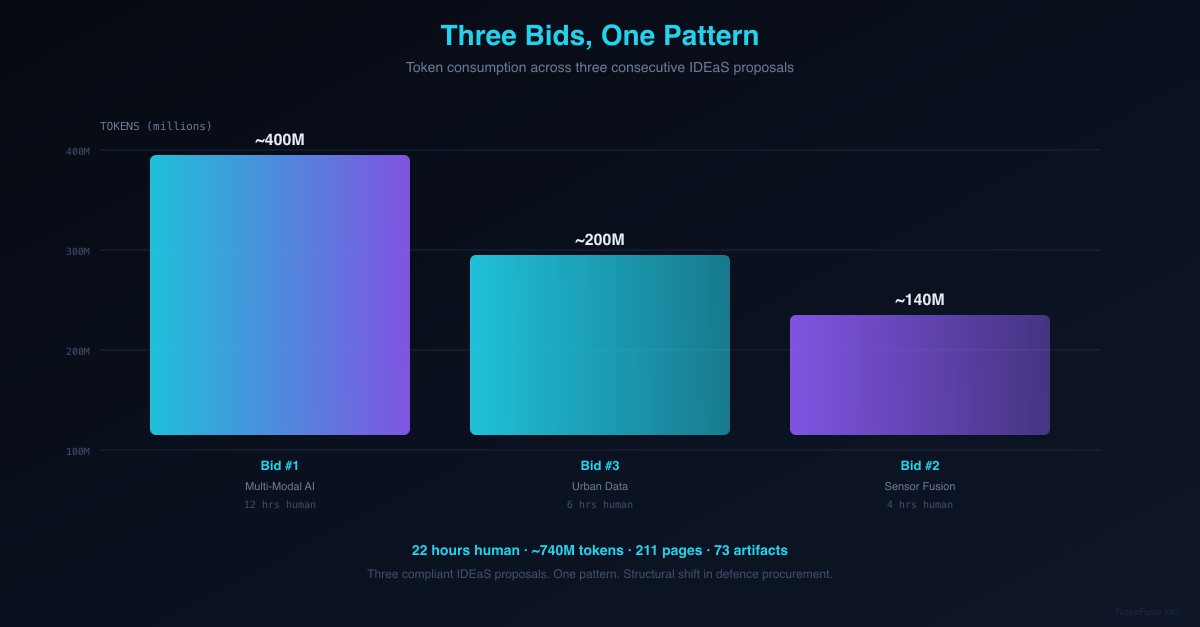
In our previous post, we shared measured token consumption data for the first two IDEaS proposals NovaFuse submitted in June 2026. Response #1 (Multi-Modal AI) consumed ~400M tokens across 7 sessions. Response #2 (Sensor Fusion) consumed ~140M tokens across 3 sessions — 66% less, thanks to pattern reuse and a tighter human-AI feedback loop.
We've now submitted a third bid. The data is better — and more nuanced.
Response #3: Turning Urban Data into Real-Time Insight Through AI
| Metric | Value |
|---|---|
| Human time invested | ~6 hours |
| AI agent time | ~20 hours of autonomous work |
| Total tokens consumed | ~200M |
| Context windows compacted | 3 |
| Artifacts produced | 19 files (~2,800 lines) |
| PDF output | 50 pages (main) + 1-page synopsis |
| Additional deliverables | Synopsis JPG, risk matrix diagram, architecture diagram, portal text responses (MC-2, PRC-1 through PRC-7, GBA Plus, Desired Outcomes, Solution Progression) |
| Human tasks | Strategic direction, cost reconciliation review, portal text refinement, final certification |
Bid #3 lands between #1 and #2 in token count. Why isn't it lower than #2?
Three reasons:
1. Higher complexity. Bid #3 required restructuring the Statement of Work into sequential activities summing to exactly 13 weeks per milestone — a formatting constraint that required multiple iterations. The cost reconciliation across SOW and Cost Proposal surfaced a $2,000 internal discrepancy that took several rounds to resolve.
2. More portal text fields. Bid #3 required substantially more portal text: MC-2 (S&T alignment), seven PRC responses (3,000 characters each), GBA Plus, Desired Outcomes, and Solution Progression to follow-on components. Pure writing output that doesn't produce reusable artifacts.
3. More visual deliverables. Bid #3 was the first to include an architecture diagram and risk matrix in the synopsis, plus a standalone synopsis PDF and JPG. Designing these visuals and iterating on layout consumed tokens that Bid #2 did not.
What the Human Actually Did (6 hours)
| Activity | Time |
|---|---|
| Initial strategic briefing (challenge selection, TRL 1→3, architecture approach) | 1 hour |
| Cost reconciliation oversight (reviewing math, approving fixes) | 1.5 hours |
| Portal text review and refinement (MC-2, PRC responses, GBA Plus) | 1.5 hours |
| Synopsis design feedback (layout iterations, visual approval) | 1 hour |
| Final review and certification | 1 hour |
Total: 6 hours (~33M tokens per human hour — the leverage ratio continues to improve)
Cumulative Impact
| Bid | Human Time | Tokens | PDF Pages | Artifacts | $/Page |
|---|---|---|---|---|---|
| #1: Multi-Modal AI | 12 hrs | ~400M | 86 | 29 files | ~$140 |
| #2: Sensor Fusion | 4 hrs | ~140M | 75 | 25 files | ~$530 |
| #3: Urban Data | 6 hrs | ~200M | 50 + synopsis | 19 files | ~$497 |
| TOTAL | 22 hrs | ~740M | 211 + synopsis | 73 files | ~$285 avg |
Three compliant proposals. 211 pages of technical documentation. 73 artifacts. 22 hours of human time. ~740M tokens total.
The Trend Line
The cost per proposal is not linear — it depends on complexity, formatting requirements, and the degree of human iteration.
But the key insight is this: the human-to-token ratio keeps improving.
- Bid #1: ~33M tokens per human hour
- Bid #2: ~35M tokens per human hour
- Bid #3: ~33M tokens per human hour
The ratio is stable — meaning the AI does roughly the same amount of work per human hour regardless of bid complexity. The difference is that complex bids require more human hours, not less efficient human hours.
Cumulative average: ~340M tokens per proposal, ~7.3 hours human time per proposal.
What This Means
The traditional defence proposal model — 5-10 people, 2-4 weeks, $40,000-$160,000 in labour — is not wrong. It is optimized for a world where human beings write every paragraph, check every requirement, and format every table.
NovaFuse operates in a different paradigm. The AI agent writes, researches, formats, and verifies. The human directs, reviews, and decides. The result is not a lower-quality proposal — it is a proposal produced at a cost structure that changes the economics of bidding.
A two-person company can now pursue three concurrent opportunities at the same time that a traditional firm pursues one. That is not a marginal improvement. It is a structural shift in who can participate in defence procurement.
NovaFuse Inc. is an Ottawa-based Canadian AI company. 100% Canadian-owned, 100% Canadian content. PBN 779566371PG0001.