AI for Cyber Resilience in Defence — Protecting the Digital Backbone
June 16, 2026 — Cyber Resilience — AI Threat Detection — Zero Trust — Five Eyes
The Threat Is Already Inside
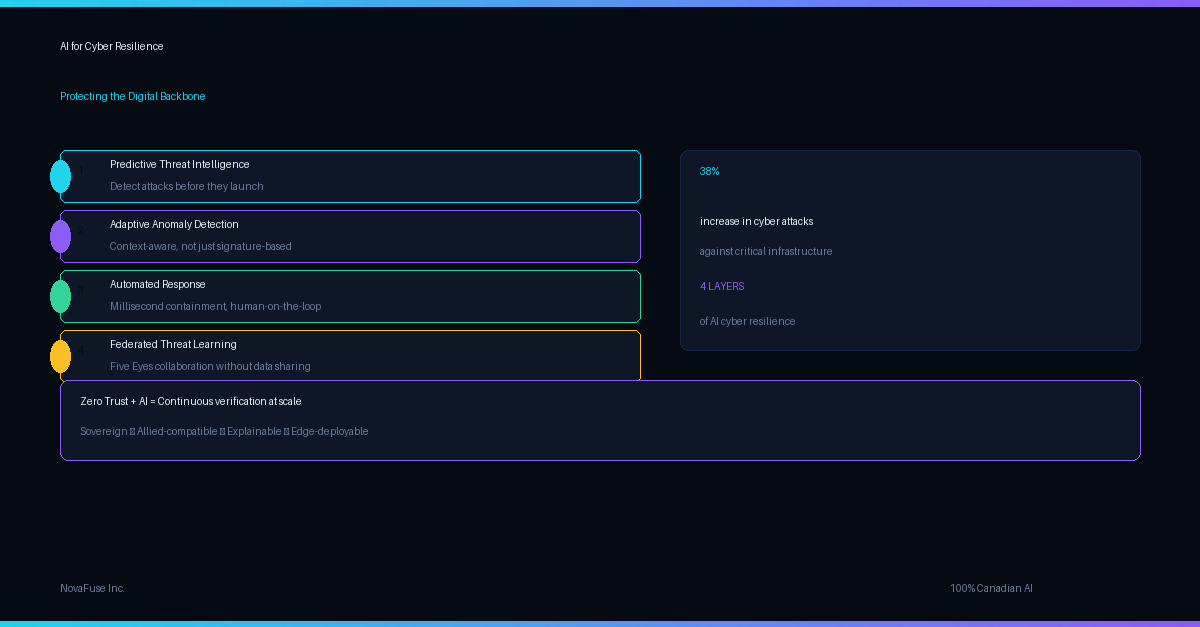
In 2023, the Canadian Centre for Cyber Security reported a 38 per cent increase in cyber attacks against critical infrastructure. The following year, the Communications Security Establishment warned that state-sponsored actors — primarily from China, Russia, Iran, and North Korea — were targeting Canadian defence contractors at an unprecedented scale. The message was clear: the digital backbone of national defence is under siege.
The challenge is not merely technical. It is structural. Defence networks must balance two competing imperatives: the need for rapid, seamless information sharing across allied coalitions, and the need to protect classified systems from increasingly sophisticated adversaries. Traditional perimeter-based security — firewalls, intrusion detection systems, signature-based antivirus — was designed for a world where threats were slower, networks were static, and the boundary between trusted and untrusted was clear. That world no longer exists.
AI offers a fundamentally different approach to cyber resilience. Not just faster detection, but adaptive defence — systems that learn from attacks in real time, predict threats before they materialize, and coordinate responses across distributed networks without compromising operational security.
Why Defence Cyber Security Is Different
Commercial cyber security focuses on protecting data and revenue. Defence cyber security focuses on protecting national security, military operations, and human lives. The stakes are categorically different, and so are the constraints.
Adversaries are nation-states. Unlike criminal hackers motivated by profit, state-sponsored actors have virtually unlimited resources, patience, and strategic objectives. Advanced Persistent Threats can lurk in networks for months or years, exfiltrating intelligence and positioning for future disruption.
The attack surface is enormous. Modern defence networks span classified and unclassified enclaves, coalition partner systems, cloud infrastructure, edge devices in deployed environments, and legacy systems that cannot be easily patched or replaced. Each connection point is a potential entry vector.
Classification boundaries create blind spots. A cyber operator monitoring a Secret-level network may have no visibility into threats targeting the adjacent Top Secret enclave. This information asymmetry allows adversaries to exploit the seams between classification domains — a technique known as "cross-domain exploitation."
Speed of response is critical. In a commercial environment, a breach might mean data loss or downtime. In defence, a cyber attack can disable command and control systems, compromise mission planning, or blind sensor networks at the moment of greatest need.
The AI Cyber Resilience Stack
AI-powered cyber resilience for defence operates across four layers:
1. Predictive Threat Intelligence
Traditional threat intelligence is reactive: analysts identify indicators of compromise after an attack has occurred and distribute signatures to defenders. AI inverts this model.
Machine learning models trained on network telemetry, dark web intelligence, and historical attack patterns can identify pre-attack indicators — reconnaissance activity, infrastructure staging, phishing campaign preparation — days or weeks before an attack is launched. Natural language processing models scan open-source intelligence in multiple languages to detect adversary planning and tool development.
For defence, this predictive capability is transformative. Instead of responding to the last attack, defenders can anticipate the next one.
2. Adaptive Anomaly Detection
Signature-based detection fails against novel attacks. AI-powered anomaly detection builds behavioural baselines for every user, device, and network segment, then flags deviations in real time.
The key innovation is contextual awareness. A user accessing an unusual file at 3 AM might be suspicious in a corporate environment but perfectly normal for a defence analyst working on a time-sensitive operation. AI models that incorporate operational context — mission schedules, deployment timelines, coalition exercise calendars — dramatically reduce false positives while catching genuine threats.
3. Automated Response and Containment
When a threat is detected, the speed of response determines the damage. AI-powered Security Orchestration, Automation, and Response platforms can execute containment playbooks in milliseconds — isolating compromised segments, revoking credentials, deploying countermeasures — far faster than any human operator.
For defence networks, this automation must be carefully calibrated. An automated response that disconnects a critical sensor network during a live operation could be as damaging as the attack itself. The solution is human-on-the-loop autonomy: AI executes pre-approved response patterns while keeping human operators informed and in control of escalation decisions.
4. Federated Threat Learning Across Allies
Here is where AI cyber resilience intersects with the Five Eyes alliance. Each ally — Canada, the United States, the United Kingdom, Australia, and New Zealand — faces the same state-sponsored adversaries. But classification barriers prevent sharing raw threat data.
Federated learning solves this. Instead of sharing classified threat indicators, each ally trains a local AI model on their own data, then shares only the model updates — not the underlying data. The result is a collective threat intelligence model that benefits from all five nations' experience without compromising any single nation's classified information.
This is not theoretical. The Five Eyes Signals Intelligence sharing framework already operates on similar principles. Federated learning extends this model to cyber defence, creating a shared AI-powered immune system across the alliance.
Zero Trust and AI: A Natural Partnership
The Department of National Defence's adoption of Zero Trust Architecture is a strategic imperative. Zero Trust operates on a simple principle: never trust, always verify. Every user, device, and data flow is continuously authenticated and authorized, regardless of network location.
AI is the engine that makes Zero Trust practical at scale. Manual verification of every access request across a defence network with millions of transactions per second is impossible. AI models evaluate risk scores in real time, considering user behaviour, device posture, data sensitivity, and operational context to make access decisions in milliseconds.
The combination of Zero Trust and AI creates a defence network that is not just harder to breach, but harder to exploit even when breached — because lateral movement is continuously monitored and constrained.
The Canadian Advantage
Canada's cyber ecosystem is uniquely positioned for defence cyber resilience. CSE's Canadian Centre for Cyber Security is one of the world's leading cyber defence organizations. Canadian universities — Carleton, uOttawa, the University of Waterloo — produce world-class cyber security research. And Canada's role in the Five Eyes alliance provides access to allied threat intelligence that few other nations possess.
NovaFuse's approach combines federated learning, edge AI, and explainable AI to create cyber resilience solutions that are:
| Characteristic | Description |
|---|---|
| Sovereign | Data and models stay within Canadian classification boundaries |
| Allied-compatible | Federated learning enables Five Eyes collaboration without data sharing |
| Explainable | Every AI decision is auditable, meeting military accountability requirements |
| Edge-deployable | AI models run on tactical platforms, not just centralized data centres |
Connecting the Threads
This post brings together the core themes of the NovaFuse blog series:
- Secure Information Sharing (Blog #15): The privacy-preserving AI techniques that enable coalition cyber defence.
- Sovereign AI (Blog #7): The principle that Canada's most sensitive cyber defence must be built and controlled in Canada.
- Five Eyes SIGINT (Blog #10): The federated intelligence sharing model that extends to cyber defence.
- Federated Learning (Blog #8): The learning paradigm that makes allied collaboration possible without compromising classified data.
Conclusion
Cyber resilience is not a technology problem. It is a strategic imperative. As adversaries become more sophisticated and the attack surface continues to expand, defence organizations need AI-powered solutions that can predict, detect, respond, and learn — faster than any human team operating alone.
Canada has the talent, the alliances, and the strategic motivation to lead in this domain. The question is not whether AI will transform defence cyber resilience, but whether Canadian innovators will be the ones to build it.
Learn more about NovaFuse's capabilities: