AI for Defence Supply Chain Resilience
From Fragile to Antifragile — How AI Transforms Defence Logistics
Introduction
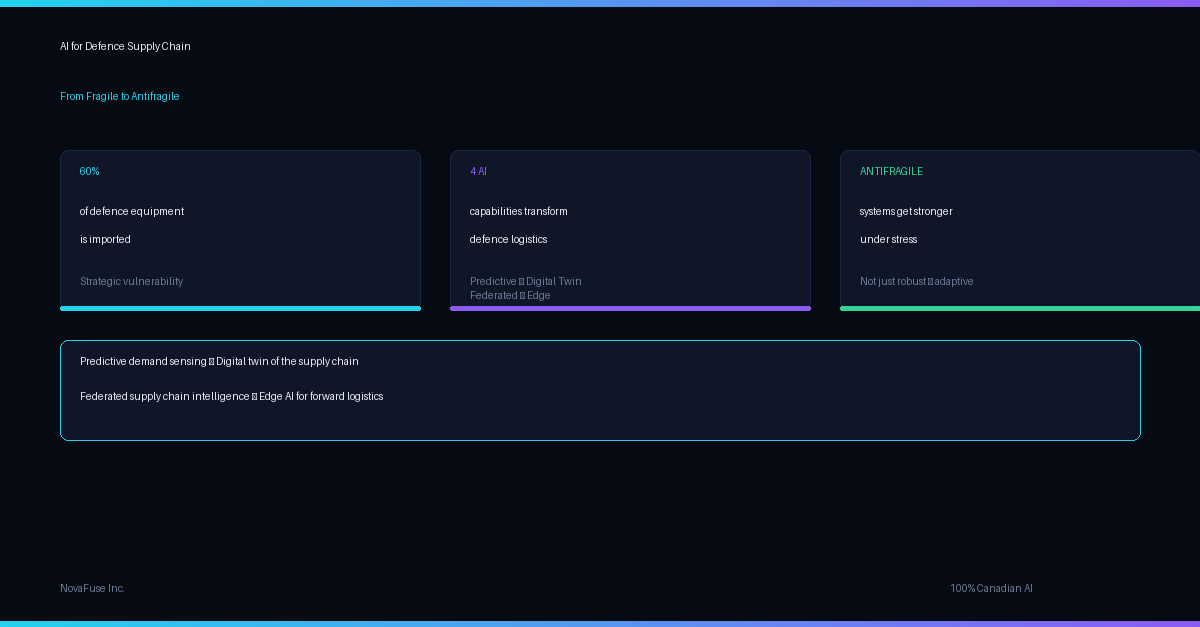
In February 2022, Canada pledged $4.9 billion in military aid to Ukraine. Within weeks, the global defence supply chain — already strained by pandemic-era disruptions — buckled. NATO allies competed for the same munitions, the same microelectronics, the same shipping lanes. Lead times for critical components stretched from weeks to years. And Canada, which imports approximately 60 per cent of its defence equipment, discovered an uncomfortable truth: sovereignty without supply chain resilience is just a slogan.
The problem is not unique to Canada. The United States Government Accountability Office reported in 2024 that over 1,100 major defence systems experienced critical supply chain shortages. The United Kingdom's Ministry of Defence acknowledged that its just-in-time logistics model — optimized for peacetime efficiency — was fundamentally incompatible with the demands of great-power competition.
AI offers a path forward. Not the incremental improvement of better spreadsheets, but a fundamental shift: from reactive procurement to predictive supply chain intelligence, from centralized planning to distributed resilience, from fragile systems that break under stress to antifragile systems that get stronger.
Why Defence Supply Chains Break
Defence supply chains are uniquely vulnerable for three structural reasons:
Long Production Cycles, Short Decision Windows
A modern fighter aircraft takes 10–15 years to design and produce. But the geopolitical decision to deploy that aircraft — or to surge production of munitions — can happen in days. The supply chain must be able to compress a decade of procurement into months, a capability that most defence industrial bases have atrophied since the Cold War.
Single Points of Failure
Critical components — specialized alloys, rare earth magnets, advanced semiconductors — often have single-source suppliers, sometimes in countries that may not be allies during a conflict. The 2023 Global Semiconductor Shortage exposed how a single factory fire in Japan could halt automotive production worldwide. In defence, the consequences of single-source dependency are measured in national security, not quarterly earnings.
Classification Barriers
Defence supply chains operate across multiple classification levels. A logistics planner managing unclassified inventory may not know that a critical component is being held up by a classified procurement process. This information asymmetry creates blind spots that propagate delays across the entire chain.
The AI Supply Chain Stack
Building a resilient defence supply chain requires four interconnected AI capabilities:
1. Predictive Demand Sensing
Traditional defence procurement relies on historical consumption patterns and fixed replacement schedules. This works in peacetime but fails during surges. AI-driven demand sensing integrates operational data (fleet readiness rates, exercise schedules, deployment timelines), geopolitical indicators (alliance commitments, threat assessments), and supplier intelligence (lead times, capacity constraints, geopolitical risk) to forecast demand months or years before it materializes.
For the Canadian Armed Forces, this means predicting spare parts demand for a NORAD surge before the order is issued — not after aircraft are already grounded.
2. Digital Twin of the Supply Chain
Just as a digital twin of a military platform models its physical condition, a digital twin of the supply chain models the flow of materials, components, and finished goods from raw material to deployed system. This virtual replica enables logistics planners to simulate disruptions — a supplier failure, a shipping lane closure, a sudden demand surge — and test mitigation strategies before they are needed.
NovaFuse's digital twin architecture, already applied to platform-level predictive maintenance, extends naturally to the supply chain level. The same sensor fusion and uncertainty quantification techniques that predict when an engine will fail can predict when a supply chain will break.
3. Federated Supply Chain Intelligence
Here is the hard truth: the most valuable supply chain data is also the most sensitive. A defence contractor knows its own suppliers, lead times, and capacity constraints — but sharing that information with competitors or even allies creates security and commercial risks. A government knows its operational requirements — but sharing them with industry before a procurement is announced creates fairness and classification issues.
Federated learning solves this. Instead of centralizing sensitive supply chain data, federated learning trains AI models across distributed datasets. Each participant — each contractor, each government agency, each allied nation — keeps its data local. The model learns from all of them without any single party seeing another's data. The result is a collective intelligence that no single participant could achieve alone, built on a foundation of data sovereignty.
This is directly applicable to Five Eyes logistics coordination: allied nations can build shared supply chain resilience models without revealing classified procurement plans or proprietary supplier relationships.
4. Edge AI for Forward Logistics
In deployed environments — a Canadian task group in the Indo-Pacific, a NATO battlegroup in the Baltics, a NORAD forward operating location in the Arctic — supply chain decisions must be made locally, in real time, with limited connectivity. Edge AI enables forward logistics nodes to autonomously manage inventory, predict consumption, and reroute supplies based on operational conditions.
The same model compression techniques that enable edge AI for sensor processing apply to logistics: a lightweight inference engine on ruggedized hardware can run supply chain optimization models without requiring connectivity to a continental data centre.
The Canadian Opportunity
Canada's defence supply chain challenge is also its opportunity. As a mid-sized allied nation with a sophisticated technology sector but a limited industrial base, Canada cannot compete with the United States on production volume. What Canada can do is lead on supply chain intelligence — the AI layer that makes every nation's defence supply chain more resilient.
The IDEaS program's "Turning Urban Data into Real-Time Insight Through AI" challenge is directly relevant: the same distributed sensing and AI analytics that repurpose urban infrastructure for situational awareness can be applied to supply chain monitoring. And the "Reliable AI Sensor Fusion" challenge maps directly to the multi-source data integration required for supply chain digital twins.
For NovaFuse, the supply chain resilience narrative unifies the entire technology stack: multi-modal fusion for integrating disparate supply chain data sources, digital twins for modelling the end-to-end chain, federated learning for allied coordination, edge AI for forward logistics, and uncertainty quantification for risk assessment.
From Fragile to Antifragile
Nassim Nicholas Taleb's concept of antifragility — systems that gain from disorder — is the right design goal for defence supply chains. A fragile supply chain breaks under stress. A robust supply chain withstands stress. An antifragile supply chain gets stronger: it learns from disruptions, adapts its behaviour, and emerges more resilient.
AI is the enabling technology for antifragile supply chains. Not AI as a static optimization tool, but AI as a continuous learning system that improves with every disruption, every surge, every unexpected event. The goal is not to predict the future perfectly — it is to build a supply chain that can respond to any future.
Canada needs this. NATO needs this. And the technology to build it exists today.
NovaFuse builds AI systems for defence resilience — from sensor fusion to supply chain intelligence. Learn more about our capabilities or read our research.
Learn more about NovaFuse's capabilities: