AI for Predictive Maintenance in Defence
From Reactive to Proactive Readiness
A CF-18 squadron receives an alert: an engine vibration anomaly detected on an aircraft scheduled for a NORAD alert patrol in six hours. Under the old model, the aircraft would be grounded for inspection — a 48-hour process that takes a critical asset out of the readiness pool during a period of heightened Arctic activity. Under the new model, an AI system cross-references the vibration signature against thousands of historical patterns, determines the anomaly is within acceptable tolerances for a 12-hour window, and recommends continued operation with enhanced monitoring. The patrol launches on time.
This is the promise of AI-driven predictive maintenance for defence: not just reducing costs, but directly increasing operational readiness. For the Canadian Armed Forces — maintaining fleets of aircraft, ships, and vehicles across the world's second-largest country, from the Arctic to the Indo-Pacific — the difference between reactive and proactive maintenance can be measured in mission capability, not just dollars.
The Cost of Reactive Maintenance
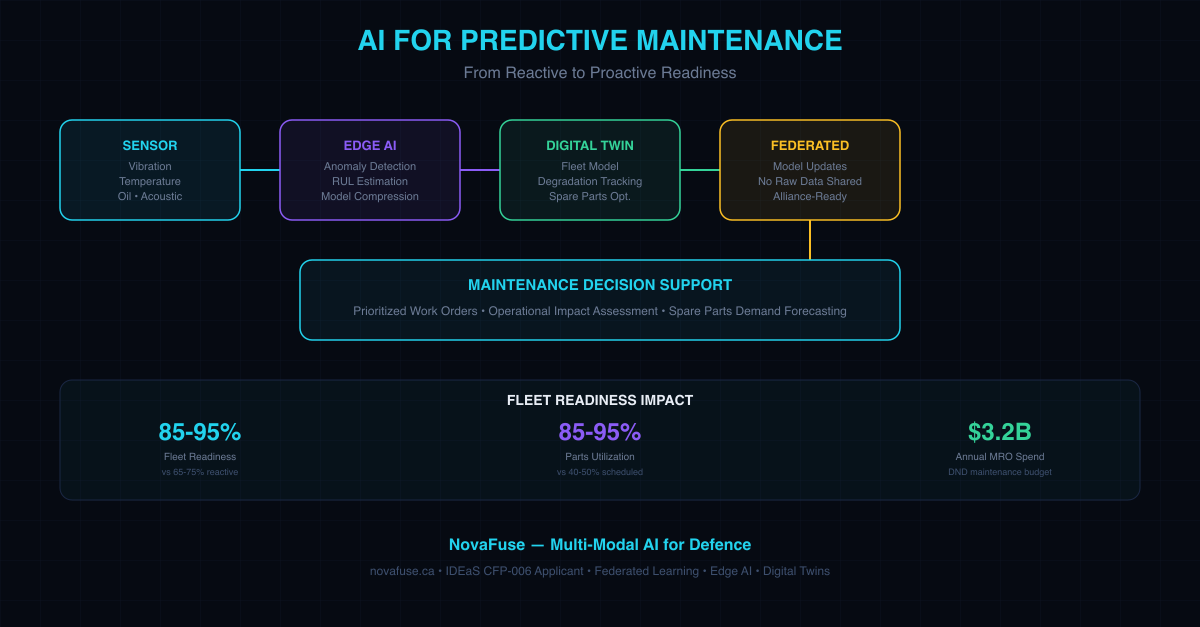
The Department of National Defence spends approximately $3.2 billion annually on maintenance, repair, and overhaul (MRO) of military equipment. Studies by the Auditor General have repeatedly flagged readiness shortfalls across all environments — the Royal Canadian Navy has struggled to maintain its frigate fleet at operational readiness, the Royal Canadian Air Force has faced spare parts shortages that ground aircraft, and the Canadian Army's vehicle fleet has aged beyond planned service life.
The traditional maintenance model follows two approaches:
Scheduled maintenance — Replace parts and perform inspections at fixed intervals, regardless of actual condition. This is simple but wasteful: parts that still have useful life are replaced early, and the approach cannot catch failures that occur between intervals.
Reactive maintenance — Run equipment until it fails, then repair it. This maximizes part life but creates unpredictable downtime, cascading failures, and safety risks. In a defence context, an aircraft that fails during a NORAD intercept mission isn't just an inconvenience — it's a gap in continental defence.
Both approaches share a fundamental limitation: they treat maintenance as a discrete event rather than a continuous process informed by real-time data.
The Predictive Maintenance Paradigm
Predictive maintenance (PdM) uses sensor data, historical patterns, and machine learning to estimate the remaining useful life (RUL) of components before they fail. Instead of asking "Is this part broken?" it asks "How long until this part will break, and what's the optimal time to replace it?"
The technical stack for defence-grade predictive maintenance has four layers:
1. Sensor Layer — Continuous Condition Monitoring
Modern military platforms are instrumented with vibration sensors, temperature probes, oil debris monitors, acoustic emission sensors, and strain gauges. The challenge isn't collecting data — it's collecting the right data at the right frequency. Too little data and the AI can't detect early failure signatures. Too much and the system drowns in noise.
For deployed platforms — a CP-140 Aurora on a maritime patrol, a Leopard 2 tank on exercise in Latvia, a Halifax-class frigate in the North Atlantic — the sensor data must be processed at the edge. Sending raw telemetry back to a continental data centre for analysis introduces latency and depends on communication links that may be contested or unavailable.
2. Edge AI Layer — Real-Time Anomaly Detection
This is where NovaFuse's edge AI capabilities directly apply. A lightweight inference engine running on ruggedized hardware at the platform level can process sensor streams in real time, detect anomalies, and trigger alerts — all without requiring connectivity to a central system.
The key technical challenge is model compression: a deep learning model that achieves 99% accuracy in a lab environment may be too large to run on the compute hardware available in a forward operating location. Techniques like quantization, pruning, and knowledge distillation can reduce model size by 10-100x while maintaining detection accuracy within acceptable bounds.
3. Digital Twin Layer — Fleet-Level Modelling
A digital twin of a military platform — a virtual replica that mirrors the real-time condition of every major subsystem — enables fleet-level optimization. Instead of maintaining each platform independently, maintenance planners can compare across the fleet, identify systemic issues, and allocate spare parts where they're most needed. This is where the digital twin concept (explained in our Digital Twins for Defence) becomes operationally critical. A digital twin doesn't just model the physics of a platform — it models the degradation of every component over time, informed by real sensor data from the actual platform.
4. Federated Learning Layer — Cross-Fleet Intelligence Without Data Sharing
Here's the challenge: the most accurate predictive models are trained on data from the entire fleet. But in a defence context, sharing raw maintenance data across platforms — let alone across allied nations — raises security and sovereignty concerns. A frigate's engine telemetry reveals operational patterns. An aircraft's vibration data reveals mission profiles.
Federated learning (covered in FedEdge) solves this: each platform trains a local model on its own data, and only the model updates — not the raw data — are shared and aggregated. The fleet gets smarter collectively without any single platform exposing its operational data.
The NORAD Readiness Connection
Predictive maintenance isn't just a logistics optimization — it's a NORAD readiness multiplier. Consider the current NORAD modernization context:
- F-35 integration into NORAD operations requires maintaining a new fleet alongside legacy CF-18s
- Arctic operations (see Arctic Surveillance) stress aircraft and vehicles beyond normal operating parameters
- Increased Russian long-range aviation activity means more intercept missions, more wear on aircraft, more demand on maintenance crews
- The North Warning System — a chain of radar stations across the Arctic — requires continuous maintenance in the harshest environment on Earth
An AI-driven predictive maintenance system that can forecast component failures 30-60 days in advance, prioritize maintenance actions by operational impact, and optimize spare parts logistics across the northern tier would directly address multiple NORAD modernization priorities simultaneously.
Key Metrics: What Good Looks Like
| Metric | Reactive Model | Scheduled Model | Predictive Model |
|---|---|---|---|
| Unplanned downtime | High | Medium | Low |
| Parts utilization | 60-70% | 40-50% | 85-95% |
| Maintenance labour | High (emergency) | Medium (routine) | Optimized |
| Safety incidents | Higher | Medium | Lower |
| Fleet readiness | 65-75% | 70-80% | 85-95% |
| Data required | Minimal | Minimal | Continuous |
IDEaS and the Path to Adoption
The IDEaS program's Test Drives mechanism is particularly relevant for predictive maintenance technologies. Test Drives provide CAF operational feedback on mature technologies — exactly the kind of validation that a predictive maintenance system needs to transition from prototype to procurement.
The "Reliable AI Sensor Fusion for Real World Missions" challenge (currently open) is also directly relevant: predictive maintenance is fundamentally a sensor fusion problem, combining multiple sensor modalities to assess component health. A proposal that frames predictive maintenance as a sensor fusion application — with compliance-by-design for defence security requirements — would align with the challenge's stated objectives.
NovaFuse's Approach
NovaFuse's technology stack maps directly to the predictive maintenance challenge:
- Multi-modal sensor fusion — Combining vibration, thermal, acoustic, and oil debris data into a unified health assessment
- Edge AI inference — Running compressed models on ruggedized hardware at the platform level
- Digital twin integration — Fleet-level degradation modelling informed by real-time sensor data
- Federated learning — Cross-fleet intelligence without compromising operational security
- Uncertainty quantification — Providing confidence intervals on RUL estimates (see Uncertainty Quantification)
The result is a system that doesn't just predict failures — it quantifies the uncertainty in those predictions, enabling maintenance planners to make risk-informed decisions about when to act.
Conclusion
Predictive maintenance is one of the highest-ROI applications of AI in defence. It directly increases fleet readiness, reduces costs, and improves safety — outcomes that matter to every level of the CAF, from the maintenance technician on the flight line to the NORAD commander making deployment decisions.
For Canada, with its vast geography, harsh climate, and constrained defence budget, the case for AI-driven predictive maintenance isn't just compelling — it's urgent. The technology exists. The data exists. What's needed is the integration layer that turns sensor data into actionable maintenance intelligence, at the edge, in real time, without compromising operational security.
That's the problem NovaFuse is solving.
Learn more about NovaFuse's capabilities: