AI for Autonomous Swarm Operations — Coordinating the Many
Distributed multi-agent coordination at the edge. How federated learning and multi-modal fusion enable swarm intelligence for defence.
Modern defence operations increasingly involve coordinating dozens — sometimes hundreds — autonomous assets simultaneously. From drone swarms conducting wide-area surveillance to unmanned surface vessels patrolling coastal waters, the challenge isn't building a single intelligent agent. It's orchestrating many agents that must cooperate, adapt, and persist in contested environments where communication is degraded and decisions happen at the edge.
This is the swarm coordination problem, and it's one of the hardest challenges in defence AI.
The Swarm Coordination Challenge
A single autonomous system is complex enough. It must perceive its environment, fuse sensor data, make decisions, and act — all within strict size, weight, and power constraints. Now multiply that by 50, 100, or 500 agents that must operate as a cohesive unit.
Three fundamental problems emerge:
- Distributed Perception. Each agent has a limited sensor footprint. A single drone sees only what's in its camera frame. A swarm, however, can cover vast areas — but only if agents share and fuse their observations into a coherent collective picture. This requires multi-modal fusion across agents, not just within a single platform.
- Decentralized Decision-Making. In contested environments, a central command node is a single point of failure. Swarms must make decisions locally while maintaining global coordination. This is where federated learning becomes essential: agents learn from each other's experiences without centralizing sensitive data or relying on continuous connectivity.
- Adaptive Coordination. Swarms must reconfigure in real time as agents are lost, conditions change, or mission objectives shift. Static plans fail. The coordination layer must be as adaptive as the individual agents.
NovaFuse's Approach: Federated Swarm Intelligence
Our multi-modal fusion architecture extends naturally to swarm operations through three integrated capabilities:
Cross-Agent Multi-Modal Fusion
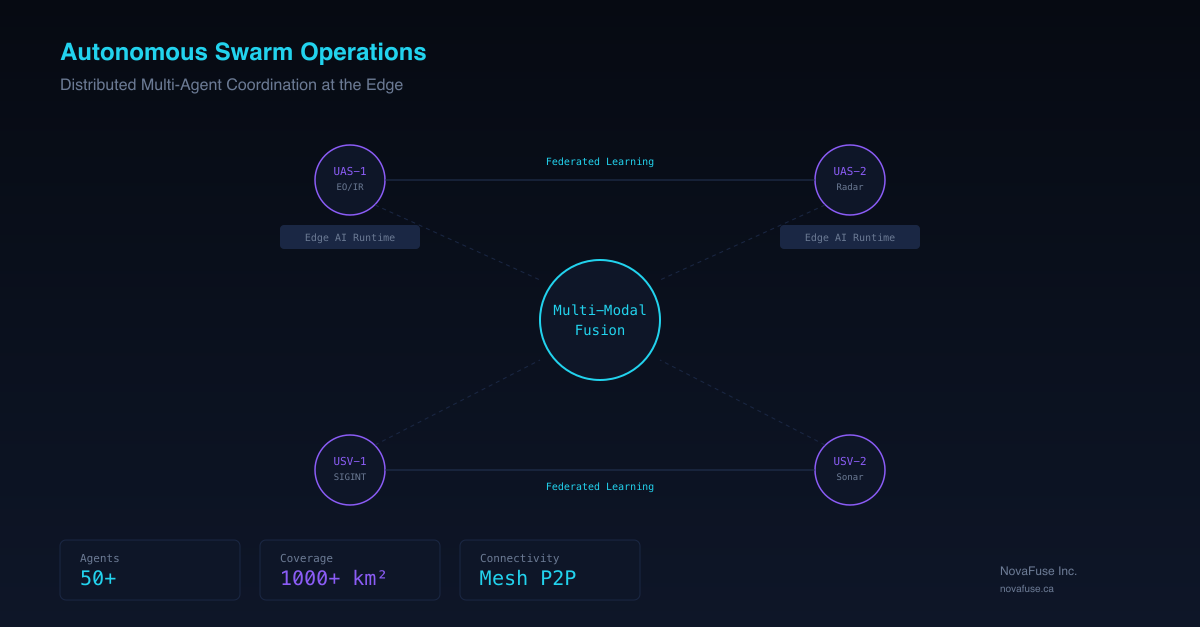
Rather than treating each agent as an isolated sensor platform, our fusion engine treats the swarm as a distributed sensing network. Observations from multiple agents — electro-optical, infrared, radar, signals intelligence — are fused into a unified operational picture. Bayesian uncertainty quantification ensures that conflicting observations are resolved with calibrated confidence, not naive averaging.
Federated Learning for Collective Adaptation
Swarm agents learn from each other through federated learning. When one agent encounters a new threat signature or terrain type, that knowledge propagates across the swarm without raw data ever leaving the agent. This preserves operational security while enabling collective intelligence. The swarm gets smarter with every mission, and no single compromise exposes the group's learned behaviour.
Edge-Native Coordination
Our edge AI runtime enables swarm coordination to run locally on each agent. There is no dependency on cloud connectivity or central command. Agents negotiate task allocation, deconflict flight paths, and share tactical updates through peer-to-peer mesh networking. The swarm persists even when individual agents are lost or communication is jammed.
Defence Applications
- Wide-Area Surveillance. A swarm of 50 small UAS can patrol thousands of square kilometres — far more efficiently than a handful of large platforms. Multi-agent fusion creates a persistent, gapless surveillance picture that no single platform could achieve.
- Counter-Swarm Defence. Defending against adversary swarms requires detecting, tracking, and engaging multiple simultaneous threats. Our Bayesian fusion engine maintains probabilistic tracks on dozens of targets, quantifies uncertainty, and recommends engagement priorities based on threat assessment.
- Distributed Electronic Warfare. Swarm agents can coordinate electromagnetic operations — mapping adversary emissions, localizing transmitters, and applying targeted jamming — all through decentralized coordination.
- Autonomous Logistics. Swarm coordination applies to ground and maritime logistics convoys. Unmanned supply vehicles can navigate contested routes, reroute around threats, and maintain formation without human operators — critical for sustaining forward operations.
Technical Architecture
| Layer | Function | NovaFuse Technology |
|---|---|---|
| Distributed Fusion | Cross-agent sensor integration | Multi-modal Bayesian fusion engine |
| Collective Learning | Swarm-wide knowledge sharing | Federated learning with differential privacy |
| Mesh Coordination | Decentralized task allocation | Edge-native consensus algorithms |
Why This Matters Now
The proliferation of autonomous systems across defence forces creates an urgent coordination challenge. NATO's DIANA programme, Canada's IDEaS challenges, and the US DoD's Replicator initiative all point in the same direction: the future of defence is many autonomous systems working together, not single platforms operating alone.
Canada has a strategic opportunity here. Our expertise in Arctic operations, our Five Eyes intelligence partnerships, and our growing defence AI ecosystem position us to lead in swarm coordination technology — particularly for the harsh, connectivity-denied environments where swarm intelligence matters most.
Conclusion
Autonomous swarm operations represent the next frontier in defence AI. The challenge isn't just making individual agents smarter — it's making the collective more capable than the sum of its parts. NovaFuse's federated multi-modal fusion architecture provides the technical foundation for exactly this kind of distributed, adaptive, edge-native intelligence.
The swarm is coming. The question is whether it will be coordinated by Canadian technology.
Related Reading: FedEdge — Federated Learning for Tactical Edge AI | AI for Counter-UAS | AI for Electronic Warfare | Multi-Modal Sensor Fusion for NORAD Modernization
Explore our capabilities: NovaFuse Services | Research Publications
We are an IDEaS CFP-006 applicant. NovaFuse Inc. — 100% Canadian AI.